

Absentee Owner vs. Hands-On Owner
Absentee Owner vs. Hands-On Owner
It’s no secret that owning a business comes with significant responsibilities, but what’s often overlooked is how the approach to ownership—whether hands-on or absentee—can influence the business’s success and value. Both hands-on and absentee ownership can lead to a lucrative and thriving business, but the way each is managed can either enhance or diminish its worth. In this article, we’ll explore these two ownership styles, examining their differences, pitfalls, and benefits, to help business owners choose the path that best supports their goals and maximizes their business’s potential.
Hands-On Owner
Hands-on ownership (or active involvement) is simply referring to a business owner being physically present at the place of business, whether that’s operating the business or serving as upper management over a team of employees. While the necessity for hands-on involvement may differ based on the business type, or circumstances may not allow it, for most owners, the benefits of being actively engaged cannot be overstated. When owners are actively involved in daily operations, they can ensure that every aspect of the business aligns with their vision and standards. Such involvement is typically a factor in maximizing the income potential of a business for several reasons.
Hands-on Owner Benefits
- Elevating Service Quality: An engaged owner brings personal investment into the business, leading to meticulous attention to detail and a genuine concern for customer satisfaction. This often results in higher service standards, increased customer loyalty, and repeat business.
- Fostering Employee Development: Hands-on owners play a crucial role in mentoring and training employees, which can improve performance, increase job satisfaction, and reduce turnover. This investment in staff development leads to a more skilled and motivated workforce that will also lead to improved customer satisfaction.
- Enhancing Operational Efficiency: Direct involvement allows owners to oversee inventory management and work scheduling, making informed decisions that streamline operations, reduce waste, and control costs, ultimately increasing the profitability of the operation.
- Identifying Growth Opportunities: Hands-on owners can be better positioned to identify and implement simple growth strategies as needed, keeping their business ahead of the competition.
Drawbacks of Hands-On Ownership
- Time and Energy Demands: Hands-on ownership demands a significant investment of time and energy, which can be particularly challenging in businesses with complex or labor-intensive operations. The owner’s deep involvement in every aspect of the business can be overwhelming and may lead to burnout, reducing both personal well-being and the ability to focus on strategic growth.
- Limited Flexibility: Being heavily involved in the day-to-day operations can limit an owner’s flexibility, making it difficult to pursue other ventures, take breaks, or focus on larger business initiatives. This hands-on approach often ties the owner to the business, restricting opportunities for expansion or diversification that require attention beyond the immediate operational needs.
- Potentially Lower Business Value: A business that is overly dependent on its owner can suffer from reduced market value when the time comes to sell. Potential buyers may view the business as a risky investment if they believe it will struggle to succeed without the current owner’s direct involvement. This perception can lead to a lower valuation, making it harder for the owner to achieve a favorable exit.
Minimizing the Drawbacks of Hands-On Ownership
While hands-on management can drive business success, it also risks creating an over-reliance on the owner, which can be problematic when planning for an exit. To balance active involvement with long-term sustainability, owners should consider the following strategies:
- Limit Daily Operational Involvement: To avoid burnout and make the business more appealing to potential buyers, owners should reduce their involvement in day-to-day operations. Delegating tasks to employees or implementing streamlined processes can help free up the owner’s time, making the business appear more manageable and less dependent on their presence.
- Avoid the “One-Person Show” Pitfall: Ensuring that the business is not overly reliant on the owner is crucial for its long-term sustainability. By building a strong, well-trained team and delegating key responsibilities, the owner can create a business that thrives independently. This not only enhances the business’s resilience but also increases its attractiveness to potential buyers, who will see it as a stable investment.
- Avoid Branding Tied to the Owner: If the business brand is closely linked to the owner’s personal identity—through their name, reputation, or personal relationships with customers—this can create uncertainty for a new owner. Buyers may fear that customers will leave when the original owner does, leading to a loss in business value. Business owners can avoid having their brand tied too closely to their personal identity by focusing on creating a strong, independent brand that stands on its own merits. This can be achieved by developing a unique brand identity that is distinct from the owner’s persona, such as using a business name and logo that do not directly reference the owner. Additionally, fostering customer loyalty through exceptional products, services, and experiences—rather than personal relationships—can help ensure that the brand remains strong even after the original owner departs. Encouraging employees to take on prominent roles in customer interactions and business operations can also shift the focus from the owner to the team, further solidifying the brand’s independence and making the business more appealing to potential buyers.
Absentee Owner
Absentee ownership, where the business owner remains largely uninvolved in the day-to-day operations, can appear to be an ideal solution for those seeking passive income. However, this strategy is rarely as simple as it seems. Successfully managing a business remotely demands not only financial investment but also a deep understanding of the industry, effective management skills, and a solid operational framework. Operating under an absentee model is rarely in the best interest of the business and revenues may be impacted as a result. There are still key benefits that outweigh the risks or drawbacks associated with such this style of ownership.
Absentee Owner Benefits
- Maximum Flexibility: Absentee ownership offers unparalleled flexibility, allowing owners to manage multiple businesses, pursue new ventures, or balance personal commitments without being tied to the daily operations of any single enterprise. This flexibility is particularly advantageous for serial entrepreneurs who thrive on the challenge of building new businesses or those who need the freedom to address personal or health-related matters. With a well-structured absentee ownership model, the business can continue to thrive independently, enabling the owner to focus on broader goals and interests.
- Focus on Higher Management: Absentee ownership enables business owners to shift their focus from daily tasks to higher-level management and strategic initiatives. By entrusting day-to-day operations to a competent management team or well-trained employees, owners can concentrate on critical areas such as long-term strategic planning, marketing efforts, or exploring expansion opportunities. This delegation not only allows for more effective decision-making but also empowers the management team to take ownership of their roles, fostering a culture of accountability and innovation within the business.
Absentee Owner Drawbacks
- Dependence on Key Employees: One of the major risks of absentee ownership is the heavy reliance on key managers or employees. While a strong management team is essential for the smooth operation of the business, it also creates a potential vulnerability. If these critical individuals leave or become unavailable, the business may face significant operational disruptions, leading to decreased productivity, customer dissatisfaction, or even financial loss. This dependence can also complicate succession planning and make the business less attractive to potential buyers who may be wary of this risk.
- Challenges in Maintaining Standards: Without the owner’s regular oversight, maintaining consistent service quality and operational standards can be challenging. When the owner is not present to monitor day-to-day activities, there is a greater risk that employees might deviate from established procedures or neglect customer service, leading to a decline in the overall quality of the business. This can damage the brand’s reputation over time, making it harder to attract and retain customers.
- Risk of Operational Issues: Absentee owners may find it difficult to identify and address operational inefficiencies or recognize growth opportunities in a timely manner. When the owner is not closely involved in the daily workings of the business, small issues can escalate into larger problems, and missed opportunities for innovation or improvement can result in stagnation. This lack of on-the-ground awareness can lead to reduced profitability and hinder the long-term success of the business.
Minimizing Drawbacks for Absentee Owners
For those who deem being an absentee owner an absolute requirement due to circumstances or ambitious business goals, success depends on careful planning and strategic implementation. For owners who lack management experience or do not have a plan to tackle the challenges associated with managing a business remotely, disruptions should be expected. Here are some key strategies to help minimize drawbacks and ensure smooth operations:
- Effective Employee Training: While some small businesses require new hires to have licenses or experience due to the technical nature of their work (such as hair stylists, massage therapists, truck drivers, etc.), many small businesses train employees in-house. In such cases, clear standards and operating procedures should be established, written, and demonstrated to help streamline training. While the impact of losing a key employee will still be felt, a replacement can be trained in a much shorter timeframe in businesses that implement proper training procedures.
- Open Communication Channels: Regular check-ins with management or trusted employees are crucial for addressing issues promptly and ensuring that the business runs smoothly. Owners should strive to maintain open lines of communication and not be difficult to reach, especially when managing the business remotely.
- Consistent Monitoring: Even for absentee operations, a physical presence remains a vital component for continued success. Periodic visits to the business help absentee owners stay connected with the operational realities, ensure standards are being met, and verify that assets are maintained in good condition. Also monitoring the surrounding market areas can help owners keep their ear to the ground and quickly recognize possible growth opportunities or spot new competition.
- Customer Feedback: While most reviews should be taken with a grain of salt, paying close attention to customer feedback is vital for making necessary adjustments and ensuring customer satisfaction and loyalty. Take the time to read reviews left on Google, Yelp, or other sites and learn what customers enjoy about the business that should continue to be upheld or if there are consistent complaints that could indicate much-needed areas for improvement. This is a good practice for nearly all small business owners, but absentee owners especially need to be mindful of customer feedback.
Conclusion
Deciding between hands-on and absentee ownership is a critical choice that hinges on the owner’s goals, industry experience, and personal circumstances. Hands-on ownership allows for direct control over service quality, operational efficiency, and business growth but comes with the cost of significant time and energy investment. On the other hand, absentee ownership provides greater flexibility and freedom but requires a solid management team and a robust operational structure to mitigate risks. By thoughtfully evaluating these differences, business owners can choose the ownership style that best aligns with their vision and sets their business up for long-term success. If you’re seeking opportunities to acquire a business and become either an absentee owner or a hands-on owner, V-AID has your back! Check out our business for sale page and find the right opportunity for you!
Read More
Business Acquisition Financing Options
Business Acquisition Financing Options at a Glance
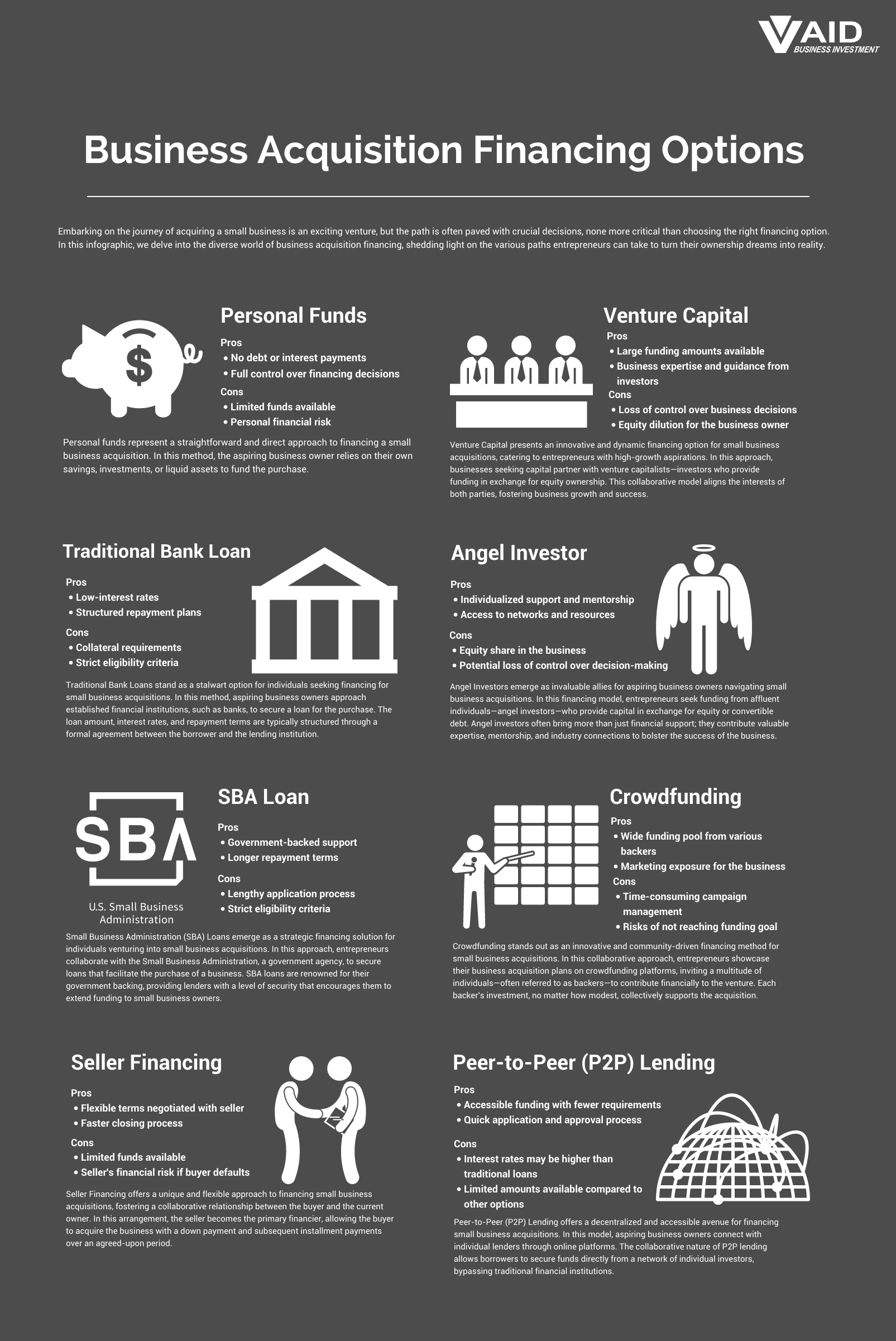
Embarking on the exciting journey of acquiring a business? Understanding the diverse landscape of business acquisition financing options is paramount to your success. In this brief exploration, we’ll shed light on various financing avenues available, empowering you with the knowledge to make informed decisions. Whether you’re a seasoned entrepreneur or a first-time buyer, navigating the financing landscape is a crucial step toward realizing your business acquisition goals. Let’s unravel the possibilities together and pave the way for a successful acquisition journey.
Make Informed Decisions
In conclusion, the realm of Business Acquisition Financing Options offers a spectrum of avenues to facilitate your entrepreneurial endeavors. Whether you opt for traditional bank loans, venture capital, SBA loans, or explore innovative alternatives like crowdfunding or seller financing, each option presents unique advantages and considerations. By carefully assessing your business needs, financial capabilities, and risk tolerance, you can select the financing strategy that aligns best with your goals. Remember, thorough research, diligent planning, and expert guidance are essential components of navigating the complex landscape of business acquisition financing. As you begin your journey to business ownership, feel free to check out our Buying Guide or join our growing network of qualified buyers by completing our Buyer Registration. Armed with this knowledge, you’re well-equipped to embark on your acquisition journey with confidence and pave the way for a successful venture. Here’s to your entrepreneurial success and the realization of your business ownership aspirations!
Read More
Personal Guarantee – A Comprehensive Guide
Welcome to our comprehensive guide on Personal Guarantees. This critical financial instrument, often overlooked, can make a significant difference in securing loans for small businesses or startups. In this blog post, we’ll delve into the nuances of personal guarantees, providing a clear understanding of their nature, potential benefits, and the risks involved. Whether you’re a budding entrepreneur or an established business owner, this guide aims to shed light on all you need to know about Personal Guarantees. Stay tuned as we unravel the complexities of this financial tool.
Definition of Personal Guarantee
A Personal Guarantee represents a formal pledge made by a person, typically the proprietor of a business, assuring to meet repayment commitments of a loan or other financial obligations should the business fail to do so. This commitment is legally binding and carries significant financial implications. When the business is incapable of meeting its obligations, the individual’s wealth comes under threat, which means their assets could be seized or liquidated by the lender or creditor. This might include property, vehicles, savings, or any other possessions of value. It is, therefore, a decision that must not be taken lightly and requires careful consideration of its potential consequences. It’s a clear indication of the individual’s faith in the success of their business and their willingness to risk a personal financial loss to ensure its survival.
Purpose and Scope of a Personal Guarantee
A personal guarantee is a vital component of many financial transactions, predominantly functioning as a safeguard for lenders. In essence, it is an enforceable legal commitment made by an individual, typically the business owner, who consents to assume personal responsibility for the financial obligations of their business.
The breadth of a personal guarantee is extensive, generally encompassing any financial deficit if the business finds itself unable to fulfill its repayment obligations. This encompasses the principal amount of the debt, the interest accrued, and often any costs or fees associated with the debt collection process. The scope of financial obligations can extend to various forms of debt, including but not limited to business loans, lines of credit, and other similar financial liabilities.
It is of utmost importance for guarantors to comprehend the magnitude of their liability under a personal guarantee. This is critical because these obligations frequently extend to their personal assets, which may be seized to repay the debt should the business default on its obligations. This could include personal property, savings, and investments, potentially jeopardizing the guarantor’s financial stability. Hence, the implications of a personal guarantee are far-reaching, and the decision to provide such a guarantee should be made with caution after seeking appropriate legal and financial advice.
Why Lenders Require Personal Guarantees
Financial institutions, such as banks and private lenders, often require personal guarantees when approving loans. A personal guarantee is a legally binding assurance made by an individual, often a business owner or significant stakeholder, committing themselves to repay the loan in the event of the borrower’s inability to meet the repayment obligations. This provides the lender with a security net, reducing their exposure to financial risk in the possibility of default.
In the context of small business loans, personal guarantees become particularly important. This is because small businesses, especially those in their nascent stages, might not possess sufficient assets or have an established credit history. These factors could potentially make it difficult for them to secure a loan based solely on their financial standing.
A personal guarantee, therefore, balances this equation. By introducing a guarantee into the lending agreement, lenders gain a level of confidence in their decision to provide the loan. This confidence stems from the knowledge that repayment is more likely, given that another financially able party is legally responsible for settling the debt if the primary borrower defaults. In this way, personal guarantees significantly mitigate the risk for lenders, making them more inclined to approve loans even in cases where the borrower’s financial background may seem less than ideal. Overall, personal guarantees play a crucial role in facilitating access to capital for small businesses, thereby enabling their growth and development.
How Personal Guarantee Protects the Lender
A personal guarantee is an essential tool that lenders use to safeguard themselves against potential loan defaults. This mechanism is fundamentally a legally binding undertaking made by the borrower—or even another individual—that they will repay the loan if the borrowing entity cannot fulfill its repayment obligations. The personal guarantee serves as an added security for the lender, ensuring that their investment will be recouped even if the borrowing entity encounters grim financial circumstances, such as bankruptcy.
The role of a personal guarantee within the framework of lending is to reduce the financial risk for the lender significantly. It operates as a deterrent for borrower default while simultaneously affording the lender a greater degree of protection. In the event of a loan default, the lender can legally pursue the guarantor for the repayment of the outstanding debt, thus securing their financial interests.
In essence, a personal guarantee is akin to a safety net for the lender, ensuring that their loan will be repaid under practically any circumstances. It’s a reassurance that even in adverse situations, such as a business folding or a borrower declaring bankruptcy, the lender can still anticipate the recovery of their funds. This provides peace of mind to the lender and potentially opens up lending opportunities to borrowers who may not have qualified for a loan without including a personal guarantee.
The Risks Associated with Personal Guarantees
Personal guarantees come with significant risks that should never be overlooked. The most glaring risk is the exposure of your personal assets, including your home, car, and other valuable possessions, to potential seizure. This means that all your personal assets could be at risk if your business venture fails. Creditors, in an attempt to recover their money, may resort to confiscating your personal property, thereby leaving you in a precarious financial position.
Further compounding the risk, personal guarantees can also have a profoundly negative impact on your credit score. If your business cannot meet its financial obligations and you, as the guarantor, cannot step in to cover the difference, this failure to meet the guaranteed obligations could be reflected in your credit score. The resulting low credit score could severely hamper your ability to secure future loans or credit, exacerbating your financial woes.
Last but certainly not least, personal guarantees can severely threaten your relationships. If you have solicited funds from friends or family members under the binding promise of a personal guarantee, any resultant financial loss or strain could give rise to tension, conflict, and the potential deterioration of these relationships. This places your financial health at risk and can endanger the interpersonal ties you hold dear. Therefore, the decision to provide a personal guarantee should be made with extreme care only after considering all potential repercussions.
Mitigating Potential Risks with Personal Guarantee
While a Personal Guarantee can be a viable tool in securing financial arrangements, it inherently carries a degree of risk by exposing your personal assets to potential liability. However, there are several steps one can take to manage and mitigate these risks:
· Understanding the Terms: Before entering into any agreement that involves signing a Personal Guarantee, it is crucial to comprehend the terms and conditions in their entirety. Not only should you be aware of the breadth and extent of the liabilities you’re assuming, but also, you should also diligently look for any clauses that might limit your liability or provide you with some protective cover. Understanding the ”fine print” is crucial to assessing the potential risks and rewards of signing a Personal Guarantee.
· Negotiation: Do not underestimate the power of negotiation. Try to negotiate the terms of the guarantee with your lender. Whether it is setting a cap on the amount you’re personally liable for or limiting the duration of the guarantee, negotiation could potentially narrow down the extent of your risk.
· Asset Protection: Consider proactively implementing measures to shield your personal assets. One viable strategy is to transfer your personal assets into an asset protection trust. This can help safeguard your assets from creditors while maintaining a degree of control over them.
· Insurance: Various insurance products are designed to cover the cost of a Personal Guarantee. This could serve as a financial safety net, providing you with an added layer of security.
· Legal Advice: It is essential to consult with a legal expert before signing a Personal Guarantee. A legal professional can provide valuable insight into the potential implications and ensure you understand your obligations’ full extent.
Remember that prevention is often the best cure. If possible, it is advisable to avoid personal guarantees and consider them only as a last resort when all other options have been thoroughly explored. Always approach Personal Guarantees with caution, fully understanding their potential consequences on your financial landscape.
Legal Rights and Responsibilities of the Guarantor
A personal guarantor is a person who willingly takes on the responsibility for another individual’s financial obligation, specifically debt or contractual performance. This occurs in the instance that the original party, colloquially referred to as the principal debtor or obligor, defaults on their initial obligation to meet the terms of the debt or contract. Typically, the role of a personal guarantor comes into play when the principal debtor is viewed as a risky candidate, possibly due to a lack of credit history or an unstable financial situation.
When considering the legal rights of a personal guarantor, a few key points stand out. Firstly, the guarantor has the right to receive information about the obligated loan or lease in a timely manner and with full transparency. This ensures that the guarantor is always well-informed and aware of the financial situation. Secondly, in the unfortunate event that the primary borrower defaults on their loan or lease, the personal guarantor has the legal right to take legal action or seek legal recourse.
Conversely, the personal guarantor is also bound by certain legal responsibilities. The primary responsibility is the obligation to repay the debt if the original borrower defaults. Should the primary borrower not meet their financial obligations, the personal guarantor is legally bound to step in and make the necessary payments. Additionally, the guarantor has the duty to maintain a certain level of assets that would adequately cover the debt repayment. In some cases, the guarantor may also be held responsible for any fees or costs that arise due to the primary borrower’s default.
Given the gravity and potential ramifications of being a personal guarantor, an individual must fully comprehend their legal rights and responsibilities before agreeing to such terms. It is always advisable to consult with a legal expert to ensure one is not unknowingly entering an unfavorable agreement.
Key Aspects to Consider Before Signing a Personal Guarantee
Before you put pen to paper and commit to a personal guarantee, several critical factors are worth serious consideration. The first one is the scope of your liability. You need to understand what you are taking responsibility for entirely. Is it the entire loan amount, or does your liability only count toward a portion? This aspect is crucial as it will dictate the potential financial burden you might face should things take a turn for the worse.
Secondly, consider performing an in-depth analysis of your future financial capabilities. Make sure you have a clear and realistic financial forecast. Can you handle the cost without causing significant personal financial strains in case the business cannot meet its obligations and defaults on the loan? Weigh this aspect carefully, as the repercussions of defaulting could be potentially damaging.
Moreover, it’s pertinent to consider the impact a personal guarantee could have on your credit. If, for whatever reason, the business defaults and you are unable to meet the obligations of the guarantee, your personal credit score could take a significant hit. This could lead to difficulties in securing personal loans in the future or even impact your chances of obtaining a mortgage.
Lastly, perhaps crucially, don’t forget to explore alternative options. Are there other avenues you can pursue that could secure the loan but pose less of a risk to your personal finances? It could be beneficial to seek advice from a financial advisor, who may be able to guide you toward other viable options.
Thus, each of these factors should be carefully considered, and it’s highly recommended to consult with a professional financial advisor before signing a personal guarantee. This way, you can ensure that you make an informed decision that accounts for all potential risks and repercussions.
Read More
Buying a Business – What you need to know
Buying a Business
Are you thinking of buying a business in Dallas? If so, you need to know the ins and outs of the process. From finding qualified business brokers who can help guide you through the process to understanding all the legal documents involved, a lot goes into purchasing a business. That’s why it’s essential to be well-informed before taking such an important step. In this blog post, we will provide an overview of what you need to know when buying a business in Dallas with the help of experienced business brokers. We’ll cover topics like how to find reliable broker services, key considerations for choosing which businesses are right for you, and more. With this information, buyers can confidently move forward with their search for success!
Understand the Process of Buying a Business
Buying a business is a complex process, and it’s essential to understand all the steps involved. In Dallas, professional business brokers can provide invaluable assistance in finding the right business for sale and negotiating the best deal. Business brokers in Dallas have an extensive network of businesses across many industries and are knowledgeable about local market conditions, legal issues, financing options, and more. They can help ensure that buyers receive a fair price for their purchase and that all necessary documents are properly filed. With their expertise in the market, business brokers Dallas can provide buyers with peace of mind throughout the entire process so they can focus on launching and running their new venture.
Once the right business is found and a fair price is negotiated,
buyers will need to draft a purchase agreement that clearly outlines the terms of the sale. Business brokers in Dallas can help facilitate this process and work
with both buyer and seller to ensure all necessary paperwork is filed
correctly. Additionally, they may be able to suggest financing options or
provide assistance on other aspects of the transaction.
On closing day, buyers should also have their attorney
review all documents before signing. This will ensure that their interests are protected, and any potential pitfalls or risks are addressed. Business brokers in Dallas can provide valuable advice throughout the process so buyers can make an informed decision when purchasing a business. With their expertise and guidance, buyers can feel confident they are getting the best deal and making wise choices for their future.
Buying a business can be an exciting and rewarding experience if
done correctly. With the help of a knowledgeable business broker in Dallas, buyers can have peace of mind that their purchase is being handled professionally and efficiently. Business brokers in Dallas will provide invaluable assistance throughout every step of the process – from initial research to closing day – so buyers can ensure they’ve gotten the best deal for their new venture.
Research Potential Businesses to Buy
When researching potential businesses to buy, it is important to consider various factors to make an informed decision. Research should include in-depth industry analysis, market conditions, and the business’s current financial and operational performance. Potential buyers should also look into any issues related to legal compliance or other regulatory matters. A thorough due diligence process, including financial projections and customer/supplier reviews, should also be conducted. Proper research will help ensure that potential buyers receive maximum value for their money and can capitalize on future opportunities presented by acquiring the business. Ultimately, having all relevant information at your fingertips will enable a buyer to make a more informed decision and develop the best possible strategy for success.
When researching potential businesses to buy, it is critical to consider multiple aspects of the business to make a sound investment decision. Not only should buyers conduct a thorough financial analysis, including reviewing balance sheets, income statements, and cash flow statements and evaluating any debt or equity financing needs, but they should also assess the industry landscape to identify competitive threats and opportunities. Additionally, buyers should examine the operational performance of the business by evaluating production capabilities, customer service offerings, and supplier contracts. Furthermore, buyers should be mindful of any legal or regulatory compliance issues that may arise and look into customer and supplier feedback as part of the due diligence process. By taking these steps, buyers can increase their chances of success when acquiring a business, as they will have all the information necessary to develop an effective strategy and capitalize on future growth opportunities.
Connect with a Local Business Broker in Dallas
Connecting with a local business broker in Dallas can be an invaluable resource for entrepreneurs looking to buy or sell a business. With their expertise, detailed market insights, and deep knowledge of the Dallas business landscape, local business brokers can ensure you get the best price possible when buying or selling. Their relationships with other local businesses can also help connect you with potential buyers or sellers. An excellent local broker will take the time to understand your individual needs and objectives before providing tailored advice on achieving them for the best possible outcome. When finding the right local business broker in Dallas, do your research and find one who is experienced and well-connected. Ask around and read online reviews to understand how reliable the broker is before making your decision. Once you have found the right broker, they can provide invaluable guidance and advice. A good connection with your local business broker in Dallas can make all the difference when buying or selling a business there. Make sure you find one who meets your criteria and will be committed to helping you reach your goals. With their help, navigating the complexities of buying or selling in Dallas will be much easier.
With many years of experience specializing in mergers and acquisitions, a local business broker from Dallas can tell you exactly what types of businesses are trending in the area and which are likely to give you the best return for your investment. They will also be able to point out any potential legal and financial issues that may arise, helping you avoid costly mistakes. Additionally, they can support negotiating the terms of the deal and liaising with lawyers, accountants, appraisers, and other professionals essential for a successful transaction.
The right local business broker in Dallas will help ensure that all parties involved come away from the deal satisfied without compromising your long-term objectives. With their knowledge and expertise in local markets, they can ensure that you get a great price when buying or selling a business in Dallas. Research local brokers before committing, as making or breaking your business transaction is essential. With the right business broker by your side, you will have a successful and profitable experience buying or selling in Dallas.
Prepare Your Finances for Purchasing a Business
When purchasing a business, it is crucial to be mindful of your finances and to take the necessary steps to ensure that you are adequately prepared. To start, it is essential to research the market for businesses in your industry and understand the financial details associated with each opportunity. This includes assessing the overall worth of the business, such as its current assets and liabilities, as well as potential opportunities for growth or additional expenses that may have yet to be initially visible. Additionally, it is recommended to secure any financing needed in advance. This could include taking out a loan from a bank or other financial institution, seeking investors, or simply utilizing existing savings. It is also advisable to perform any due diligence necessary before entering into an agreement with the seller. This might involve obtaining expert advice regarding taxes or legal matters, having a lawyer review any contracts involved in the sale process, or performing proper background checks on parties involved to authenticate their identities. These measures can help ensure you are adequately prepared when purchasing a business.
Perform Due Diligence on the business You Are Buying
Performing due diligence when buying a business is an essential process that should not be overlooked. It is important to thoroughly research the company, its financials, and its operations before completing the purchase. This process entails obtaining detailed information about the business, such as its financial statements, customer base, contracts, and liabilities. Key areas of focus should include:
- Understanding the current market position of the company.
- Analyzing past performance.
- Evaluating assets and liabilities.
- Exploring any potential litigation or reputational issues.
- Researching vendor relationships.
- Examining key personnel qualifications.
Additionally, it is essential to review any applicable state or federal regulations that may affect the purchase or operation of the business. Finally, having a lawyer and accountant review all relevant documents before signing an agreement can help protect a buyer’sbuyer’s best interests before entering into a binding contract. A thorough due diligence process can help buyers confidently purchase a business, knowing all potential risks and opportunities have been thoroughly assessed.
It is also important to remember that the due diligence process is ongoing after a transaction has closed. Even in the most carefully structured deals, some issues may still need to be solved or become problematic during the transition. As such, businesses should continue to monitor their newly acquired assets and liabilities for any unexpected developments that may affect their success. Additionally, it’s vital to review post-closing contract obligations and ensure compliance with applicable laws throughout the integration period. Careful attention to these matters following a transaction will help maximize value and protect against potential future risks.
Negotiate and Finalize the Deal
Once the buyer and seller have completed negotiations, it is time to finalize the deal. During this stage, the parties will need to sign a purchase agreement that outlines all of the terms of the transaction. This document will include the closing date, payment details, any contingencies, warranties, or indemnities involved in the sale, and what liabilities and assets are being transferred from one party to another. Depending on the complexity of the sale and state law requirements, additional documents may also be necessary for completion. Additionally, any applicable permits or licenses may need to be obtained before completing the agreement. Once all conditions have been met and all documents signed by both parties, the closing can occur, and payments can be exchanged as agreed upon in the purchase agreement. After conclusion, the sale is complete, and both parties can celebrate their success!
At each step of the process, it is essential to ensure everything is done correctly and in accordance with applicable laws. Working with experienced professionals such as lawyers or business brokers Dallas can help make the process easier and ensure a smooth transaction for all involved. With proper preparation and guidance, purchasing a business can be an exciting and rewarding journey.
Read More

SBA Express Loan – What is it?
SBA Express Loan
The Small Business Administration (SBA) Express Loan is a government-backed loan program that provides small business owners or soon-to-be small business owners with access to capital quickly and easily. This type of loan offers generous terms like low-interest rates, flexible repayment periods, and collateral requirements that are often less stringent than those required by traditional lenders. The SBA Express Loan also features expedited approval times compared to other financing options available for small businesses. With this type of loan, businesses and buyers can receive funding quicker than traditional loans after submitting their applications – making it an ideal option for entrepreneurs needing fast access to capital.
Benefits of an SBA Express Loan
Benefits of an SBA Express Loan include:
– Low-interest rates
– Flexible repayment terms
– Quick approval process with expedited funding times
– Less stringent collateral requirements than traditional
lenders often demand
The Small Business Administration (SBA) Express Loan program provides small business owners access to fast, flexible financing options. An SBA Express Loan offers benefits such as an expedited application and approval process, lower down payments than traditional loans, and more flexible repayment terms. The maximum loan amount for an SBA Express Loan is $500,000 (an increase from a recent amount of $350,000), making it a great choice for businesses or buyers seeking quick capital to fund or purchase a business. Additionally, the SBA guarantees 85% of the loan amount – providing invaluable protection to lenders while allowing borrowers to obtain funding with less risk than other loan programs. Moreover, unlike other financing types, banks using the SBA Express Loan are not required to use credit scores as their sole assessment criteria when evaluating applications. As a result, these loans are accessible to a broader range of borrowers who would otherwise be ineligible for conventional financing.
Eligibility Requirements for an SBA Express Loan
Eligibility Requirements for an SBA Express Loan vary depending on the type of business. Generally, businesses must meet the following criteria to be eligible for loan consideration:
• Be in operation for at least two years;
• Have a good credit history and score;
• Demonstrate an ability to repay the loan;
• Have sufficient liquid assets to cover expenses during slow periods;
• Operate in an eligible industry.
In addition, some SBA Express Loan programs require a personal
guarantee from the business owner as well as collateral for the loan.
The Eligibility Requirements for an SBA Express Loan are relatively straightforward. Businesses must have been operating for at least two years and must be for-profit and not a passive investment. In addition, the business must meet size requirements based on industry and revenue. Generally, businesses that qualify must be small-sized with 500 or fewer employees. There is also a requirement for a personal credit score of 650 or higher from each principal owner with a 20% or greater ownership stake in the company. Finally, the applicant must demonstrate that other forms of financing have been pursued but were considered insufficient or unavailable to meet the capital needs of the business.
How to Apply for an SBA Express Loan
How to Apply for an SBA Express Loan is relatively straightforward. First, you’ll need to gather all the required documents and information to complete your application.
These include:
•Financial Statements
•Business Plan
•Personal Financial Statement
•Bank Statements and Tax Returns
•Legal Documents (i.e., Articles of Incorporation)
Applying for an SBA Express Loan is a relatively straightforward process, but it does require some preparation and organization. Before beginning the application process, applicants should have a comprehensive business plan that outlines their desired loan purpose and how they plan to use the funds. Additionally, applicants should provide their personal financial statements and those of any affiliates involved in the company.
Once all required documents are assembled, applicants must complete an online loan application requiring basic information such as contact details, business information, number of employees, credit history, and other related data. Applicants must also submit additional documents related to their loan requests, such as a business plan or loan proposal. Additionally, customers may be asked to provide collateral that meets SBA requirements such as real estate or equipment that can be used to secure the loan if needed. After submitting the application and required documents online or by mail, applicants will receive an acknowledgment from SBA regarding receipt of their application materials. Following a review of the submission material by SBA staff members, applicants may either receive approval or denial, along with instructions for the next steps if approved.
Types of Collateral Accepted by the SBA
The Small Business Administration (SBA) accepts a range of collateral as security for SBA Express loans. This includes tangible assets such as real estate, inventory, and equipment; intangible assets such as accounts receivable, business contracts, and patents; and personal assets such as home equity lines of credit, vehicles, retirement accounts, and investments. The SBA will usually accept the same type of collateral used to secure the loan from other lenders. Some lenders may also allow you to use general unsecured collateral such as inventory or cash flow. Ultimately, each lender will have their own set of criteria for collateral requirements for SBA Express loans.
FAQ about SBA Express Loan
If you’re considering an SBA Express Loan, here are some frequently asked questions (FAQs) about the process:
Q – Is there a minimum or maximum amount I can borrow?
A – Yes, the minimum loan amount is $25,000, while the maximum is $500,000.
Q – How long does it take for my application to be processed?
A – Generally, your application should take between three and five weeks for approval.
Q – Are there any fees associated with the loan process?
A – Yes, you’ll need to pay a fee of 3-4% of the loan amount. Additionally, an SBA guaranty fee may also apply.
Q – What is the repayment period for an SBA Express Loan?
A – You have up to seven years to repay the loan. However, this can vary based on the lender’s terms and conditions.
Q – Do I need to provide collateral to secure an SBA Express loan?
A – Yes, lenders typically ask you to provide some form of collateral to secure the loan. This could include tangible assets such as real estate, inventory, or equipment; intangible assets such as accounts receivable, business contracts, and patents; or personal assets such as home equity lines of credit, vehicles, retirement accounts, and investments.
