

SBA SOP 50 10 8.1: What Business Buyers and Sellers Need to Know Before October 1, 2026
Beginning October 1, SBA-financed business acquisitions will operate under updated rules that could have a meaningful impact on how deals are structured, underwritten, and ultimately financed.
The SBA’s new SOP 50 10 8.1 introduces changes affecting loan amortization, debt-service coverage, equity requirements, financial due diligence, seller transition periods, and working-capital financing.
For business buyers and sellers, these aren’t simply technical lending changes. They could influence how much acquisition debt a business can support, how much equity a buyer needs, and ultimately what purchase price can realistically be financed.
Some transactions will be affected more than others. Here are six changes buyers, sellers, business brokers, and M&A advisors should understand before October 1.
1. Real Estate Will No Longer Automatically Extend the Entire Acquisition to 25 Years
One of the most significant changes may affect acquisitions involving substantial commercial real estate.
Under the current rules, when real estate represents 51% or more of SBA loan proceeds, the entire loan can generally be amortized over as long as 25 years.
Under SOP 50 10 8.1, the business acquisition portion will generally be limited to a 10-year amortization, while the eligible real estate portion may extend up to 25 years. The overall loan maturity will therefore be determined using a blended or weighted-average approach.
Why does this matter?
Amortization has a direct impact on monthly debt service.
A longer repayment period generally means a lower monthly payment. Shortening the effective amortization can increase the buyer’s required debt payments even when the purchase price, interest rate, and down payment remain the same.
This could be particularly important for real-estate-heavy acquisitions such as gas stations, convenience stores, hotels, automotive businesses, certain manufacturing companies, and other businesses operating from owner-occupied commercial property.
Buyers considering these transactions should make sure their financing models reflect the new amortization structure rather than assuming the entire acquisition will qualify for a 25-year term.
2. First-Time Acquisitions Face a Higher Debt-Service Coverage Requirement
Another important change involves the minimum debt-service coverage ratio, or DSCR, for qualifying first-time acquisitions.
Under SOP 50 10 8.1, the minimum DSCR increases from 1.15x to 1.25x for these transactions.
Just as importantly, that coverage generally must be demonstrated through the company’s historical operating performance, rather than relying on anticipated improvements after the acquisition.
A buyer may have excellent plans to increase sales, improve marketing, reduce expenses, add locations, or otherwise grow the company after closing. Those plans can still be important when evaluating an acquisition, but projected improvements generally cannot be used to make an otherwise insufficient transaction satisfy the required debt-service coverage threshold.
For sellers, this places even greater importance on having strong, consistent, and well-documented historical financial performance.
For buyers, it may mean using more conservative acquisition budgets.
A business that could support a certain amount of acquisition debt under previous assumptions may support less leverage under the new requirements. Depending on the transaction, that could mean a larger equity contribution, a different deal structure, or a lower purchase price.
3. Larger Acquisitions May Require a Quality of Earnings Report
SOP 50 10 8.1 also introduces an additional financial due-diligence requirement for certain larger acquisitions.
For transactions involving a business purchase price of $3 million or more, lenders will generally be required to obtain a lender-commissioned Quality of Earnings (QoE) report.
An important distinction is that owner-occupied real estate is excluded when determining whether the business purchase price reaches the $3 million threshold.
For example, consider a $4 million transaction consisting of:
- $2.7 million for the operating business
- $1.3 million for owner-occupied real estate
Although the total transaction is $4 million, the business purchase price is only $2.7 million. As a result, the transaction may remain below the $3 million threshold that triggers the QoE requirement.
That distinction can be particularly important for acquisitions in which real estate represents a substantial portion of the overall transaction value.
For larger acquisitions without significant real estate, both buyers and sellers should be prepared for an additional level of financial review during the SBA lending process.
This also gives sellers another reason to make sure their financial records are organized, accurate, and capable of standing up to increased scrutiny before going to market.
4. Expansion Acquisitions May Receive More Favorable Treatment
Not every SBA-financed acquisition will be treated the same way.
When an existing business acquires another business within the same industry group, the transaction may qualify as a Business Expansion under the new SOP.
That distinction can potentially provide significant financing advantages compared with a first-time acquisition.
Qualifying Business Expansion transactions may retain the 1.15x debt-service coverage requirement, rather than the new 1.25x requirement applicable to qualifying first-time acquisitions.
The standard 10% equity requirement may also potentially be reduced or eliminated when the acquiring business has operated for at least two full fiscal years and the transaction satisfies the applicable SBA requirements.
This could create an important difference between prospective buyers competing for the same company.
A strategic buyer that already owns and operates a business in the industry may be able to finance an acquisition differently than an individual purchasing a business for the first time.
For sellers evaluating multiple offers, the buyer’s ability to obtain financing can be just as important as the headline offer price. Understanding whether a prospective buyer qualifies for Business Expansion treatment could therefore become an increasingly important part of evaluating the strength of an offer.
5. Sellers Can Remain Involved for Longer After Closing
The new SOP also provides additional flexibility for sellers who need to remain involved after closing.
The permitted consulting period for a departing seller is extended from 12 months to 24 months.
That can be particularly valuable when the selling owner’s relationships, experience, or institutional knowledge are important to the ongoing success of the company.
A longer transition period can provide additional time to transfer key customer and vendor relationships, operational knowledge, industry-specific processes, employee and management responsibilities, and important contracts or strategic relationships.
For buyers, this may reduce some of the transition risk associated with acquiring an owner-dependent business.
For sellers, it creates more flexibility to design a transition that protects the continuity of the company without requiring an abrupt departure immediately following the sale.
6. Acquisition Financing Can Be Paired With a Revolving Line of Credit
SOP 50 10 8.1 also provides additional flexibility for combining acquisition financing with a revolving line of credit.
Rather than financing every eligible need through long-term acquisition debt, certain transactions may be structured with a separate revolving facility to address working-capital requirements.
This can be particularly useful for companies with seasonal cash-flow needs, inventory purchases, fluctuating accounts receivable, or other short-term working-capital requirements.
The broader takeaway is that buyers should think carefully about how the business actually uses capital.
Long-term acquisition costs and short-term working-capital needs do not necessarily have to be financed the same way. Matching the financing structure to the underlying use of funds can give the acquired company greater flexibility after closing.
What Do the New SBA Rules Mean for Business Buyers?
For buyers, particularly first-time buyers, the October 1 changes make it increasingly important to evaluate financing capacity before settling on a purchase price.
The combination of a higher DSCR requirement and potentially shorter effective amortization for transactions involving real estate could reduce borrowing capacity in some acquisitions.
Historical financial performance will also become particularly important. Buyers should not assume that expected post-closing improvements will compensate for a business that does not currently generate enough cash flow to support the proposed acquisition debt.
Before submitting an offer, buyers using SBA financing should understand not only what they believe a company is worth, but also how much acquisition debt the company’s historical cash flow can realistically support under the new rules.
What Do the New SBA Rules Mean for Business Sellers?
For sellers, SOP 50 10 8.1 reinforces an important principle:
A company’s financeability can directly affect its marketability and achievable transaction value.
A business may appear to justify a certain asking price based on valuation multiples, comparable transactions, assets, or future growth opportunities. But when a significant portion of the buyer pool depends on SBA financing, the company’s historical cash flow also has to support the debt required to complete the acquisition.
If it doesn’t, buyers may need to contribute more equity, restructure the transaction, seek alternative financing, or reduce the purchase price.
That makes financial preparation increasingly important for owners considering a sale. Clean financial statements, well-supported adjustments, consistent earnings, and a clear understanding of the company’s cash flow can all play an important role in helping prospective buyers obtain financing.
The new rules could also make the type of buyer more relevant. A strategic buyer who qualifies for Business Expansion treatment may have financing options that aren’t available to a first-time buyer.
The Bottom Line
SBA SOP 50 10 8.1 doesn’t eliminate the advantages of SBA financing for business acquisitions. But beginning October 1, it changes some of the math behind those transactions.
Among the most important changes are a different amortization structure for acquisitions involving real estate, a 1.25x debt-service coverage requirement for qualifying first-time acquisitions, greater reliance on historical earnings, new Quality of Earnings requirements for certain larger acquisitions, potentially favorable treatment for qualifying Business Expansions, longer seller transition periods, and greater flexibility to pair acquisition financing with revolving working-capital financing.
For anyone considering buying or selling a business using SBA financing, the key question is no longer simply:
“What is this business worth?”
An equally important question is:
“What purchase price and deal structure can this business’s historical cash flow support under the new SBA requirements?”
With October 1 approaching, buyers, sellers, brokers, and advisors should begin evaluating transactions using the new requirements now rather than relying on financing assumptions that may no longer apply once SOP 50 10 8.1 takes effect.
If you are considering selling your business now or in the future, the new SBA requirements could affect how prospective buyers finance your business and ultimately how a transaction is structured. We invite you to contact V-AID Group for a free and confidential consultation to discuss your business, its current marketability and finance ability, and the steps you can take to strengthen your financial presentation, prepare for buyer financing requirements, and position your business for a successful sale.
This article is intended for general informational purposes only and does not constitute legal, tax, accounting, valuation, or lending advice. SBA requirements and lender underwriting practices may vary based on the transaction and borrower. Buyers and sellers should consult with an experienced SBA lender and their professional advisors regarding the requirements applicable to a specific transaction.
Read More
What Is Seller’s Discretionary Earnings (SDE), and Why Should Business Owners Care?
When business owners begin thinking about selling, one of the first questions they ask is, “What is my business worth?”
Many owners would usually assume that the answer is based on the annual revenue, the amount they’ve invested over the years, or what similar businesses are listed for online. However, in reality, most small businesses are valued very differently.
For the majority of “Main Street Businesses” that are typically purchased by individual buyers or financed through SBA loans, the most important number is Seller’s Discretionary Earnings (SDE). Understanding how SDE works can help business owners set realistic expectations, avoid pricing mistakes, and ultimately sell their business faster and for the highest market-supported value.
What Is Seller’s Discretionary Earnings (SDE)?
Seller’s Discretionary Earnings (SDE) measures the total economic benefit an owner-operator receives from a business Rather than focusing solely on accounting profit, SDE adjusts the company’s financials by adding back certain discretionary, non-recurring, or owner-specific expenses to provide a clearer picture of the cash flow available to a new owner.
It begins with the business’s pre-tax net income and adds back certain expenses that may not continue under new ownership.
Common add-backs include:
- Owner’s salary, payroll taxes, and benefits
- Personal expenses paid through the business
- One-time or unusual expenses
- Interest expense
- Depreciation and amortization
- Non-recurring legal or professional fees
- Other discretionary expenses that would not reasonably transfer to a new owner
The goal of SDE is to show the true earning power of the business for someone who purchases and operates it. Because most Main Street businesses rely heavily on the owner’s day-to-day involvement, SDE is generally the preferred earnings metric used for valuation. Larger lower middle-market businesses, on the other hand, are more commonly evaluated using EBITDA because they tend to have more established management teams and are less dependent on a single owner.
How Is SDE Calculated?
While every business is unique, a simplified calculation looks like this:
Pre-Tax Net Income
+ Owner Compensation
+ Interest
+ Depreciation
+ Amortization
+ Qualified Discretionary or Non-Recurring Expenses
= Seller’s Discretionary Earnings (SDE)
The purpose of these add-backs is to normalize the business’s earnings by removing expenses that may not continue under new ownership. This allows buyers to evaluate the true earning potential of the business rather than the financial decisions of the current owner. However, not every expense qualifies as an add-back.
To be considered, the expense should generally be discretionary, non-recurring, or unique to the current owner. Routine operating expenses (such as payroll for employees, rent, utilities, inventory, insurance, and marketing) typically remain necessary to operate the business and therefore are not added back. Each adjustment should be supported by historical financial records and a reasonable explanation. Buyers, lenders, and appraisers expect these adjustments to be documented rather than based on estimates or verbal statements.
Why Main Street Businesses Are Usually Valued Using SDE
There is no single method for valuing every business. Different industries, company sizes, and transaction types require different valuation approaches.
For most Main Street businesses, buyers are purchasing an owner-operated business that generates income. Because the owner’s involvement often plays a significant role in the business’s success, buyers focus primarily on the cash flow they can reasonably expect to earn after taking over operations.
For that reason, business brokers commonly rely on two primary valuation tools:
- Seller’s Discretionary Earnings (SDE) to determine the business’s normalized cash flow.
- Direct Market Data Method (DMDM) to compare the business against similar businesses that have actually sold.
Similar to a residential real estate appraisal, the Direct Market Data Method analyzes completed sales of comparable businesses, not asking prices, to determine the multiples buyers have actually paid. Factors such as industry, size, profitability, location, growth potential, and risk are all considered when identifying comparable transactions.
When SDE and the Direct Market Data Method are used together, they generally provide the most probable selling price that today’s market is willing to support.
Why Revenue Alone Doesn’t Determine Value
One of the most common misconceptions is that a business is worth a multiple of its annual revenue. While revenue measures how much money a business brings in through sales, it does not show how much the owner actually earns after paying operating expenses. A business with high revenue but low profitability may be worth less than a business with lower revenue and stronger cash flow.
For example:
- Business A generates $2 million in annual revenue but produces only $150,000 in SDE.
- Business B generates $1 million in annual revenue but produces $300,000 in SDE.
Although Business A generates twice the revenue, many buyers would place a higher value on Business B because it produces significantly stronger cash flow.
This illustrates why buyers focus primarily on a business’s earning potential rather than its sales volume. In many cases, a business with lower revenue but higher Seller’s Discretionary Earnings is worth more than a business with substantially higher revenue and lower profitability.
Why the Income Approach is Less Practical for Main Street Businesses
Business owners often hear about valuation methods such as the Income Approach or Discounted Cash Flow (DCF) analysis. While these methods are widely accepted in business valuation, they are generally more appropriate for larger companies with stable financial reporting, professional management teams, and predictable long-term cash flows.
Most Main Street businesses do not fit those characteristics as many are heavily dependent on the owner’s day-to-day involvement, have fluctuating earnings, and experience changes in expenses from year to year. As a result, forecasting future cash flow can be highly subjective, making an income-based valuation less practical for many small businesses.
Instead, buyers, lenders, and business brokers typically place greater emphasis on historical financial performance and actual market transactions. This is why Seller’s Discretionary Earnings (SDE), combined with the Direct Market Data Method (DMDM), is often the preferred approach for valuing owner-operated Main Street businesses, as it reflects both documented earnings and what buyers have actually paid for comparable businesses.
Does Real Estate Affect the Business Valuation?
To answer this question, it depends on if the real estate is leased because the business is typically valued separately from the property. Buyers evaluate the business based on its cash flow while also considering the lease terms, rental rate, remaining lease term, and any renewal options.
If the seller owns the commercial property, there are generally two separate assets involved:
- The operating business
- The commercial real estate
Because these assets generate value in different ways and are often financed separately, each is typically valued independently. Depending on the seller’s goals and the buyer’s financing, the business may be sold with or without the real estate.
When calculating Seller’s Discretionary Earnings (SDE), the business’s rent expense should also reflect fair market value. If the owner is paying themselves above-market or below-market rent, business brokers will often normalize the rent to current market rates. This adjustment helps present a more accurate picture of the business’s earning potential and allows buyers to evaluate the business based on what they can reasonably expect to pay after the sale.
Why Accurate Financial Records Matter
One of the biggest challenges in business valuation occurs when owners estimate their earnings based on memory rather than documented financial records.
Statements like:
- “I usually spend about…”
- “That expense averages around…”
- “I don’t think we spent that much every year.”
are difficult for buyers, lenders, and brokers to rely on because they cannot be independently verified.
An accurate Seller’s Discretionary Earnings (SDE) calculation should be supported by historical financial statements, tax returns, profit and loss statements, payroll records, bank statements, and other supporting documentation. If an expense truly qualifies as an add-back, it should be clearly identified and supported with evidence whenever possible.
Furthermore, business valuations are based on documented financial performance, not verbal estimates or assumptions. Well-organized financial records can increase buyer confidence, simplify due diligence, reduce the likelihood of valuation disputes, and help support a market value that buyers and lenders can justify.
Understanding the Difference Between Perceived Value and Market Value
It is very common for business owners to often develop an emotional connection to the businesses they have spent years building; the time, effort, and sacrifices invested are real, but the market ultimately determines the most probable value based on documented earnings, buyer demand, and perceived risk. In other words, a business is not worth what the owner hopes it is worth, worth what it costs to build, nor is it worth what similar businesses are listed for online. Ultimately, a business is worth what a qualified buyer is willing to pay based on verified financial performance, comparable market transactions, and the level of risk associated with the opportunity.
Understanding Seller’s Discretionary Earnings (SDE) is one of the most important steps in setting realistic expectations and preparing for a successful sale. Owners who understand how buyers evaluate businesses are better positioned to price appropriately, attract qualified buyers, and maximize value during negotiations. Before taking a business into the market, having your financials properly recast and your Seller’s Discretionary Earnings accurately calculated is one of the best investments you can make. Well-prepared financials build buyer confidence, streamline due diligence, and help support a valuation that reflects what the market is truly willing to pay.
Read More
Why Some Businesses Sell Quickly While Others Sit on the Market
What Makes a Business Easy to Buy and Easy to Sell?
If you’re thinking selling a business in today’s market, one of the most important questions to ask is whether the company is easy for a buyer to acquire. While strong revenue and profitability certainly matter and often help explain why some businesses sell quickly, today’s buyers are looking beyond earnings alone. They want businesses with clean financials, transferable operations, organized records, and financing options that support a smooth transaction.
Today’s business buyers are conducting more due diligence than ever before. Lenders are carefully reviewing financial performance before approving SBA financing, and buyers are scrutinizing every aspect of a business acquisition before making an offer.
As a result, some businesses attract immediate interest and receive multiple offers, while others struggle to gain traction despite producing healthy profits.
The difference, and often the reason why some businesses sell quickly while others sit on the market, often comes down to one simple question:
How easy is the business to buy and, ultimately, how easy is it to sell?
The businesses that attract the strongest buyer interest are often those that reduce uncertainty and make it easy for a buyer to envision a successful transition.
Clean Financials Make a Business Easier to Sell
One of the first things buyers evaluate when considering a business for sale is the financial performance of the company.
Today’s buyers expect detailed and accurate financial reporting. Most will review several years of tax returns, profit and loss statements, balance sheets, payroll reports, and bank statements before moving forward.
When financial records are incomplete, inconsistent, or difficult to understand, buyers become cautious. Questions arise regarding profitability, cash flow, and the overall reliability of the information being presented.
Businesses with clean financials immediately stand out. Clear reporting helps buyers verify earnings and simplifies the due diligence process.
In many cases, organized financial statements not only increase buyer confidence but can also positively influence business valuation because they reduce perceived risk.
Simply put, buyers are more likely to pursue a business acquisition when they trust the numbers.
Why Organized Business Records Matter to Buyers
Financial statements are only one piece of the puzzle.
Buyers increasingly expect organized records throughout the business, including:
-Equipment inventories
-Lease agreements
-Vendor contracts
-Employee documentation
-Customer agreements
-Licenses and permits
-Operating procedures
When records are organized and readily available, buyers can quickly verify information and move through due diligence more efficiently.
On the other hand, transactions often slow down when sellers spend weeks locating documents or attempting to recreate missing information.
Organized records demonstrate professionalism and help create confidence that the business has been managed responsibly.
For owners preparing to sell a business, maintaining accurate records can significantly improve the buyer experience.
Buyers Want Businesses That Can Run Without the Owner
One of the most important questions buyers ask is:
“What happens when the owner leaves?”
Businesses that depend heavily on the owner’s personal involvement often face greater scrutiny during the sale process.
The most attractive businesses have systems and procedures that can be transferred to a new owner.
Examples include:
-Written operating procedures
-Established employee responsibilities
-Consistent customer acquisition methods
-Defined management structures
-Repeatable workflows
When buyers see that a business can continue operating successfully after the owner exits, they feel more comfortable moving forward.
Transferable operations reduce risk and increase the pool of qualified buyers.
In today’s market, businesses that can function independently of the owner are often easier to sell, which is one of the key reasons why some businesses sell quickly while others struggle to attract buyers.
Why Low Owner Dependence Increases Business Value
Many successful businesses are built through years of personal effort and involvement. However, buyers often view excessive owner dependence as a risk.
Common signs of owner dependence include:
-The owner manages all key customer relationships.
-The owner handles every sales function.
-Major decisions require the owner’s approval.
-Critical business knowledge exists only in the owner’s head.
When buyers encounter these situations, they naturally wonder whether revenue and operations will remain stable after the transition.
Businesses with empowered employees, documented processes, and delegated responsibilities typically generate greater confidence among buyers.
Reducing owner dependence is one of the most effective ways to improve both business valuation and marketability.
Why SBA Financing Makes a Business More Attractive
Financing plays a major role in business acquisitions.
Many transactions today involve SBA financing because it allows qualified buyers to purchase a business with less upfront capital.
As a result, businesses that are considered “bankable” often attract a larger pool of buyers.
A business that qualifies for SBA financing typically has:
-Consistent cash flow
-Verifiable earnings
-Stable operating history
-Reasonable debt levels
-Clean financial reporting
When buyers know a business is likely to qualify for an SBA loan, they are often more willing to pursue the opportunity.
Conversely, businesses that cannot obtain financing may require substantially larger cash investments, limiting the number of qualified buyers.
Making a business financeable can dramatically improve buyer interest and increase the likelihood of a successful transaction.
Seller Financing Can Help Close More Deals
Although not every transaction includes seller financing, buyers generally view some level of seller participation positively.
A seller note can demonstrate confidence in the business while helping bridge financing gaps that occasionally arise during negotiations.
In many successful transactions, the seller is willing to carry a modest note for a qualified buyer to help complete the deal.
This flexibility can benefit both parties by making the transaction easier to finance and helping buyers feel more comfortable moving forward.
Seller financing is rarely the primary driver of a sale, but it can often help good deals reach the finish line.
Well-Maintained Assets Create Strong First Impressions
The condition of business assets can significantly influence buyer perception.
Buyers carefully evaluate:
-Equipment
-Furniture and fixtures
-Vehicles
-Technology systems
-Production assets
-Specialized tools
Businesses with assets in good condition generally create a stronger first impression.
Well-maintained equipment signals responsible ownership and reduces concerns about unexpected repair or replacement costs after closing.
While buyers understand that no asset remains brand new forever, they appreciate businesses that have consistently invested in maintenance and upkeep.
A business with clean, functional assets is often easier to market and easier to sell.
Modest Transition Support Reduces Buyer Risk
Many buyers, particularly first-time business owners, are concerned about the transition period following a sale.
This is why modest post-transaction support can make a business significantly more attractive.
Buyers appreciate sellers who are willing to provide reasonable training and consultation after closing.
This support may include:
-Employee introductions
-Customer introductions
-Vendor transitions
-Operational training
-General consultation during the transition period
Most buyers are not seeking long-term involvement from the seller. They simply want reassurance that guidance will be available during the initial ownership transition.
A willingness to provide post-sale support often increases buyer confidence and helps transactions close more smoothly.
Realistic Seller Expectations Help Businesses Sell Faster
One of the most overlooked factors in selling a business is the seller’s mindset.
Buyers appreciate working with sellers who understand market conditions and approach negotiations realistically.
Being realistic does not mean accepting an unreasonable offer. It means recognizing that business acquisitions involve financing requirements, due diligence, negotiation, and compromise.
Sellers who remain flexible and responsive often achieve better outcomes than those who focus exclusively on a specific purchase price.
The strongest transactions occur when both parties are committed to finding a structure that works for everyone involved.
Final Thoughts: Making a Business Easier to Sell
A business does not need to be perfect to attract serious buyers.
However, businesses that are easy to understand, finance, and transition consistently generate stronger buyer interest.
If a business owner is considering a sale in the next few years, focusing on the factors buyers care about most can significantly improve marketability:
-Clean financials
-Organized records
-Transferable operations
-Low owner dependence
-SBA financing eligibility
-Flexible deal structures
-Well-maintained assets
-Reasonable transition support
-Realistic seller expectations
The businesses that receive the strongest offers are not always the fastest growing. More often, they are the businesses that reduce uncertainty, inspire confidence, and make it easier for buyers to envision a successful transition.
By preparing well before going to market, owners can increase buyer interest, improve valuation, and position themselves for a smoother and more successful sale.
Frequently Asked Questions as to Why Some Businesses Sell Quickly
What makes a business easier to sell?
Businesses with clean financials, organized records, strong cash flow, transferable operations, and low owner dependence are generally easier to sell because buyers can more easily evaluate and finance the opportunity.
Does SBA financing help sell a business?
Yes. Businesses that qualify for SBA financing often attract a larger pool of buyers because purchasers can finance a portion of the acquisition rather than paying entirely in cash.
Why do buyers care about owner dependence?
Buyers want confidence that the business will continue performing after the seller exits. Excessive owner dependence increases risk and can negatively impact buyer interest and valuation.
Does a seller need to offer financing?
No. However, a seller willing to carry a modest note for a qualified buyer can often help facilitate a transaction and increase buyer confidence.
How important are financial records when selling a business?
Financial records are one of the most important aspects of any transaction. Clean, organized financial statements help buyers verify earnings and complete due diligence more efficiently.
What role does post-sale training play in a business sale?
Post-sale training and consultation help ensure a smooth transition, reduce buyer risk, and can make a business more attractive to prospective purchasers.
Read More
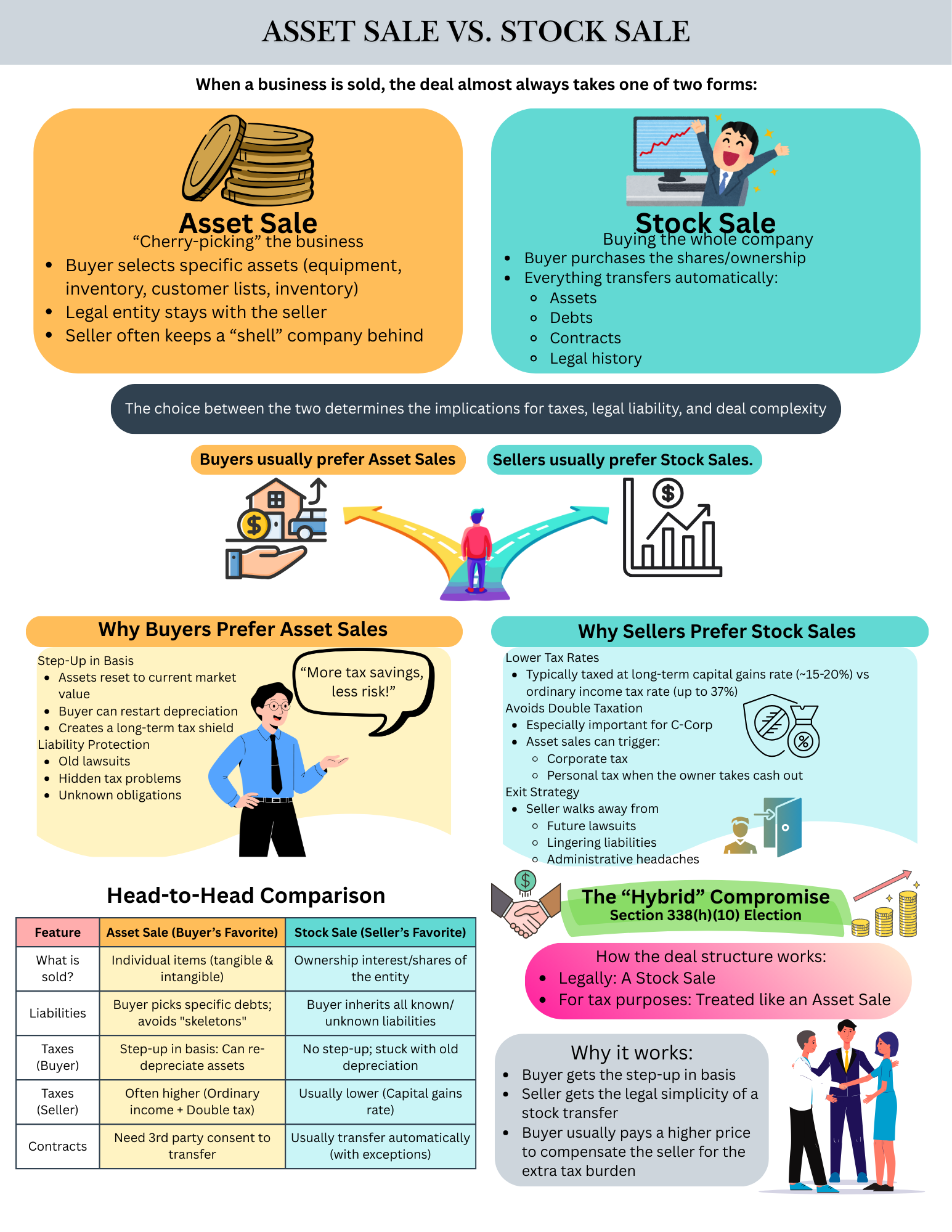
Asset Sale vs. Stock Sale: Key Differences Every Business Owner Should Know
When a business is sold, the transaction is almost always structured as either an asset sale or a stock sale. While the distinction may sound technical, the structure of the deal has major implications for taxes, legal risk, and how smoothly ownership transfers. In most transactions, buyers lean toward asset sales, while sellers typically prefer stock sales.
In an asset sale, the buyer purchases selected pieces of the business, such as equipment, inventory, customer lists, or intellectual property, rather than the company itself. The legal entity remains with the seller, often holding any leftover liabilities. In a stock sale, the buyer purchases the ownership interests of the company, meaning everything inside the entity transfers automatically, including assets, contracts, debts, and legal history.
Buyers generally favor asset sales because they offer greater protection and tax advantages. Purchasing assets allows buyers to “step up” the value of those assets for tax purposes, enabling new depreciation schedules that can reduce taxable income over time. Asset sales also allow buyers to leave behind unwanted liabilities, minimizing exposure to unknown risks.
Sellers, on the other hand, usually prefer stock sales because they are simpler and often more tax-efficient. Stock sales are typically taxed at long-term capital gains rates and can help sellers avoid double taxation, especially in C-corporation deals. Just as importantly, a stock sale allows the seller to make a clean exit, walking away from the entity and its future obligations.
In some cases, buyers and sellers compromise using a Section 338(h)(10) election, which treats the transaction as a stock sale legally but an asset sale for tax purposes. This structure gives buyers the tax benefits they want while preserving the simplicity of a stock transfer, often with a higher purchase price to balance the tax impact for the seller.

Selling Your Business? 7 Common Value Slashers
The Silent Threat to Business Owners
Most business owners think their company’s value is based mainly on revenue, profit, or how busy the business looks from the outside. But what really hurts value usually isn’t obvious on a financial statement. It hides in the way the business is run, how dependent it is on the owner, how organized (or disorganized) operations are, and how much risk sits quietly inside the company. Those issues often don’t cause daily problems, so they’re easy to ignore, until a buyer, bank, or investor starts digging.
That’s when many owners discover the truth: value isn’t usually lost in one big moment. It slowly slips away because of problems that felt “under control” for years.
In this article, we’ll break down seven common hidden value slashers most businesses have, why they matter, and what you can do to fix them before they cost you real money.
The 7 Value Slashers When Selling Your Business
#1 Owner Dependency: When the Business Can’t Breathe Without You
One of the biggest hidden threats to valuation is when the business is overly dependent on the owner. If the company can’t function when you take a vacation… if every customer insists on speaking only with you… if every decision has to cross your desk… congratulations, you haven’t just built a business, you’ve built a job you own.
Buyers don’t want to purchase someone else’s workload. They want to acquire an operation that runs predictably, consistently, and profitably without being tethered to one individual. When success is tied directly to your presence, expertise, or relationships, a buyer sees risk… and risk always reduces price, leverage, and deal structure.
The warning signs often feel like compliments:
“You’re the only one who really understands the business.”
“Nothing moves forward unless you approve it.”
“Our customers trust you more than anyone else.”
Those statements sound flattering, but they’re actually indicators that the business does not stand on its own. In due diligence, that doesn’t translate to admiration, it translates to uncertainty, transition concerns, and fear of revenue loss once you exit.
The Fix: Start building a business that can operate without you. That means developing real leadership depth, delegating decision-making authority (not just tasks) and investing in training and documented processes.
Encourage client relationships with your team, not just with you. Create a culture where you are no longer the single point of failure.
The goal is simple: if you step back, the business shouldn’t slow to a crawl… it should continue to perform. When an owner becomes optional rather than essential, valuation increases, confidence rises, and your business becomes the readily transferable, high-value asset it was meant to be.
#2 Limited Operating History: When Success Is Too New to Trust
A business can look and feel exciting when it’s growing fast, but if it hasn’t been around long enough to prove consistency, buyers get cautious. Newly established businesses, or companies with only a short window of strong performance for less than three years, often struggle to justify premium valuations simply because there isn’t enough historical data to prove the results are sustainable.
Buyers aren’t just purchasing today’s success, they’re trying to predict tomorrow’s reliability. Without a track record, that prediction becomes guesswork, and guesswork lowers price.
You’ll also recognize this situation if: your business has only been profitable for a short period, is still stabilizing revenue, recently pivoted its model, or simply hasn’t existed long enough to show multi-year proof of performance. Maybe the growth is real and momentum is strong, but there aren’t enough years of financial statements to demonstrate that it’s durable. From an owner’s perspective, it may feel obvious that success will continue. From a buyer’s perspective, it feels untested.
The Fix: Focus on building credibility and clarity. Maintain clean, accurate, professionally prepared financials from day one. Show consistent month-over-month and year-over-year improvement. Build recurring revenue where possible. Strengthen customer retention and operational stability.
Document why your success is sustainable and not accidental or short-lived. The more predictable and proven your performance becomes, the easier it is for buyers to feel confident… and the higher your valuation climbs.
#3 Messy or Unreliable Financials: When “Good Enough” Becomes Very Expensive
Nothing kills confidence faster in a deal than financials that are unclear, inconsistent, or undocumented. You may know your business is healthy, profitable, and stable, but buyers don’t purchase based on trust; they purchase based on proof.
When your books are disorganized, loads of personal expenses are mixed in, add-backs are questionable, or financial statements don’t align, what feels like “normal” to you looks like risk to a buyer. And in valuation, risk is punished every single time. Deals slow down, legal and accounting costs go up, and more often than not, the purchase price drops or the buyer walks away entirely.
If any of this sounds familiar, you’re not alone: the CPA scrambles at tax time because things haven’t been reconciled, cash flow is “managed from the bank account,” financial reports are months behind, or there’s no consistent narrative explaining performance year over year. Owners sometimes think these issues are “just paperwork.” They’re not.
They are the backbone of credibility. Buyers want to see clear earnings, quality cash flow, and financial discipline. When the numbers don’t tell a clean and verifiable story, buyers assume the worst, even if the business is actually performing well.
The Fix: Clean, professional financials are one of the fastest ways to retain business value. Invest in strong bookkeeping and accounting support. Produce timely monthly financial statements. Separate personal and business expenses. Understand what truly qualifies as an add-back. Build 2–3 years of reliable, well-documented financial history.
In short, make your financials defensible. When buyers see clarity, discipline, and transparency, confidence rises… and so does the price they’re willing to pay.
#4 Customer Concentration: When Too Much Revenue Rests on Too Few Relationships
Customer concentration is one of those value slashers that doesn’t feel like a problem until it becomes one. On the surface, having a small number of high-paying clients can feel like efficiency, stability, and partnership. But from a buyer’s perspective, it’s a flashing red warning light.
When 20%, 30%, or even 50%+ of your revenue comes from one or two key accounts, the buyer isn’t just purchasing your business… they’re essentially gambling on whether those clients will stay after you leave. If they don’t, the business they just bought could collapse overnight. That level of dependency turns what could have been a strong valuation into a discounted, heavily structured, or risky deal very quickly.
The tough reality: if one client has the power to significantly affect your financial health by leaving, renegotiating, or reducing spending, then your business doesn’t truly control its revenue, your client does. Buyers know this. Lenders know this. And in due diligence, they scrutinize it hard.
Even if that anchor client has been loyal for years, even if the relationship feels “rock solid,” buyers think in terms of risk probability, not optimism. High concentration equals uncertainty. Uncertainty equals lower prices, more earn-outs, and tougher negotiations.
The Fix: Diversification is key. Start intentionally widening your customer base so no single client holds your business hostage. Develop a strategy to attract mid-tier accounts rather than depending solely on whales. Where possible, strengthen contracts, extend terms, or create recurring revenue arrangements that lock in stability.
Going to our first value slasher, cultivate deeper client relationships across your organization so loyalty isn’t tied to you personally. Over time, aim for no single customer representing more than 10–20% of total revenue. When your revenue is spread across many reliable customers, your business instantly becomes more resilient, more transferable, and far more valuable in the eyes of a buyer.
#5 Weak or Inconsistent Profit Margins: When Busy Doesn’t Equal Valuable
A surprising number of businesses look strong on the surface; steady revenue full workloads, phones ringing, yet when you peel back the layers, the margins tell a very different story. Buyers don’t pay for how busy the business is; they pay for how profitably the business operates.
Thin or inconsistent margins signal fragility. They suggest pricing pressure, operational inefficiency, poor cost control, or a business that must run at full throttle just to survive.
When a buyer sees that profitability disappears the moment volume dips or costs rise, they see risk. And once again, risk pushes valuation down.
Here’s where many owners get caught: they chase revenue because it feels like growth. They discount to win deals. They take on unprofitable customers “for the relationship.” They maintain outdated pricing while costs quietly rise. Over time, the business becomes addicted to volume instead of disciplined around value.
During due diligence, buyers will analyze not just your revenue, but your quality of earnings, your consistency, pricing power, and resilience. If your margins wobble year to year or barely hold together, they’ll either demand a lower price, insist on heavy contingency structures, or move on to a stronger, more stable acquisition.
The Fix: Start treating margins like a strategic priority, not an afterthought. Conduct a pricing review and ensure your rates reflect current costs, labor realities, and market positioning.
Identify unprofitable products, services, or customers, and either fix them or phase them out. Tighten operational efficiencies, reduce waste, and hold the team accountable to margin targets, not just top-line goals.
Strong, predictable margins tell buyers your business is disciplined, healthy, and capable of generating dependable returns. That confidence turns into higher offers, better deal terms, and protected value.
#6 Lack of Systems, Processes, and Documentation: When Success Depends on “How We’ve Always Done It”
One of the quietest yet most damaging value slashers is a business that runs on memory, habit, and tribal knowledge instead of documented systems. Many companies grow on grit, hustle, and experience, especially founder-led companies. That works… until it doesn’t.
From a buyer’s perspective, a business without standardized processes is unpredictable. It means performance relies on individual people, not proven systems. And anything that feels unpredictable lowers confidence, complicates transition, and potentially reduces value.
You’ll recognize this problem if any of these sounds familiar:
Employees train new hires by “shadowing.” Tasks are done based on “how Susan likes it done.” The answer to most operational questions starts with, “It depends…”
Procedures live in people’s heads instead of anywhere accessible. The business functions, but it does so informally. That might feel normal day to day, but to a buyer, it looks like a house held together by experience instead of structure.
If a key person leaves, or if the buyer takes over without your team’s full support, performance can drop quickly. That risk shows up as price reductions, extended earn-outs, and hesitation.
The Fix: Turn your business into a machine rather than a personality-driven operation. Start by documenting core processes: sales workflows, service delivery, customer onboarding, financial procedures, and daily operational routines. Create SOPs (standard operating procedures) that are clear, repeatable, and accessible. Introduce technology where it creates efficiency, consistency, and visibility. Build training systems that don’t depend on one person doing all the teaching.
When your business can show buyers well-documented workflows and predictable execution, it sends a powerful message: “This company doesn’t just operate, this company knows how it operates.” And that instantly increases trust, transferability, and value.
#7 No Strategic Positioning or Differentiation: When You Look Like Everyone Else When Selling Your Business
The final hidden value slasher is one many owners never notice because it hides in plain sight: lack of differentiation. If your business sounds like every other competitor in your industry standing out with “great service,” “quality work,” “competitive pricing”, then from a buyer’s perspective, you’re a commodity.
Commodities don’t command premium valuations. When there’s nothing distinct about your offering, brand position, expertise, market niche, or customer experience, buyers assume the only level your business truly competes on is price. That means thinner margins, less loyalty, and a business that’s easier for competitors to replicate, all of which drag value down.
Here’s the uncomfortable truth: if your business disappears tomorrow, and your customers could easily replace you with another provider without much disruption, then you don’t own a strong market position, you just occupy space in it.
Buyers want companies with an edge: a brand people recognize, a niche where they dominate, intellectual property or proprietary methods, a reputation that commands respect, or a clearly defined specialty that makes them harder to replace. When none of that is present, the business may operate fine, but it doesn’t stand out, and that shows up directly in valuation.
The Fix: Get intentional about positioning. Clarify what you do better than anyone else and lean into it.
Define your specialty. Strengthen your brand presence and reputation.
Become known for something specific rather than trying to be everything to everyone. Build credibility through testimonials, case studies, market authority, and consistent messaging. Explore ways to create defensibility, recurring revenue programs, proprietary processes, exclusive relationships, or specialized expertise.
When a buyer can clearly answer the question, “What makes this business different and hard to replace?”, your perceived value increases dramatically. And that’s when your business stops being just another option and starts being a premium acquisition.
Value Doesn’t Vanish Overnight, It Slips Away Quietly
The most dangerous part about these seven value slashers is that none of them feel urgent while you’re running the business. The doors are open, customers are happy enough, revenue is coming in, and operations mostly work. That’s why so many owners are blindsided later.
These issues don’t show up as emergencies; they show up as lost valuation, tougher negotiations, demanding buyers, drawn-out due diligence, or deals that collapse right when the finish line is in sight. Value isn’t lost in dramatic moments, it erodes slowly, through risks that feel manageable… until someone else is evaluating your company from the outside.
The good news is every single one of these problems is fixable with clarity, discipline, and intention. Strengthen leadership. Clean up financials. Reduce dependency on you, on a few employees, or a handful of customers.
Build processes. Define your positioning. Treat your business like the asset it truly is, not just something you operate day-to-day. Whether you plan to sell in two years, ten years, or never, addressing these value slashers will give you more options, more leverage, and a stronger, more resilient company.
The best time to prepare was years ago.
The second-best time is right now.
Read More