

SBA SOP 50 10 8.1: What Business Buyers and Sellers Need to Know Before October 1, 2026
Beginning October 1, SBA-financed business acquisitions will operate under updated rules that could have a meaningful impact on how deals are structured, underwritten, and ultimately financed.
The SBA’s new SOP 50 10 8.1 introduces changes affecting loan amortization, debt-service coverage, equity requirements, financial due diligence, seller transition periods, and working-capital financing.
For business buyers and sellers, these aren’t simply technical lending changes. They could influence how much acquisition debt a business can support, how much equity a buyer needs, and ultimately what purchase price can realistically be financed.
Some transactions will be affected more than others. Here are six changes buyers, sellers, business brokers, and M&A advisors should understand before October 1.
1. Real Estate Will No Longer Automatically Extend the Entire Acquisition to 25 Years
One of the most significant changes may affect acquisitions involving substantial commercial real estate.
Under the current rules, when real estate represents 51% or more of SBA loan proceeds, the entire loan can generally be amortized over as long as 25 years.
Under SOP 50 10 8.1, the business acquisition portion will generally be limited to a 10-year amortization, while the eligible real estate portion may extend up to 25 years. The overall loan maturity will therefore be determined using a blended or weighted-average approach.
Why does this matter?
Amortization has a direct impact on monthly debt service.
A longer repayment period generally means a lower monthly payment. Shortening the effective amortization can increase the buyer’s required debt payments even when the purchase price, interest rate, and down payment remain the same.
This could be particularly important for real-estate-heavy acquisitions such as gas stations, convenience stores, hotels, automotive businesses, certain manufacturing companies, and other businesses operating from owner-occupied commercial property.
Buyers considering these transactions should make sure their financing models reflect the new amortization structure rather than assuming the entire acquisition will qualify for a 25-year term.
2. First-Time Acquisitions Face a Higher Debt-Service Coverage Requirement
Another important change involves the minimum debt-service coverage ratio, or DSCR, for qualifying first-time acquisitions.
Under SOP 50 10 8.1, the minimum DSCR increases from 1.15x to 1.25x for these transactions.
Just as importantly, that coverage generally must be demonstrated through the company’s historical operating performance, rather than relying on anticipated improvements after the acquisition.
A buyer may have excellent plans to increase sales, improve marketing, reduce expenses, add locations, or otherwise grow the company after closing. Those plans can still be important when evaluating an acquisition, but projected improvements generally cannot be used to make an otherwise insufficient transaction satisfy the required debt-service coverage threshold.
For sellers, this places even greater importance on having strong, consistent, and well-documented historical financial performance.
For buyers, it may mean using more conservative acquisition budgets.
A business that could support a certain amount of acquisition debt under previous assumptions may support less leverage under the new requirements. Depending on the transaction, that could mean a larger equity contribution, a different deal structure, or a lower purchase price.
3. Larger Acquisitions May Require a Quality of Earnings Report
SOP 50 10 8.1 also introduces an additional financial due-diligence requirement for certain larger acquisitions.
For transactions involving a business purchase price of $3 million or more, lenders will generally be required to obtain a lender-commissioned Quality of Earnings (QoE) report.
An important distinction is that owner-occupied real estate is excluded when determining whether the business purchase price reaches the $3 million threshold.
For example, consider a $4 million transaction consisting of:
- $2.7 million for the operating business
- $1.3 million for owner-occupied real estate
Although the total transaction is $4 million, the business purchase price is only $2.7 million. As a result, the transaction may remain below the $3 million threshold that triggers the QoE requirement.
That distinction can be particularly important for acquisitions in which real estate represents a substantial portion of the overall transaction value.
For larger acquisitions without significant real estate, both buyers and sellers should be prepared for an additional level of financial review during the SBA lending process.
This also gives sellers another reason to make sure their financial records are organized, accurate, and capable of standing up to increased scrutiny before going to market.
4. Expansion Acquisitions May Receive More Favorable Treatment
Not every SBA-financed acquisition will be treated the same way.
When an existing business acquires another business within the same industry group, the transaction may qualify as a Business Expansion under the new SOP.
That distinction can potentially provide significant financing advantages compared with a first-time acquisition.
Qualifying Business Expansion transactions may retain the 1.15x debt-service coverage requirement, rather than the new 1.25x requirement applicable to qualifying first-time acquisitions.
The standard 10% equity requirement may also potentially be reduced or eliminated when the acquiring business has operated for at least two full fiscal years and the transaction satisfies the applicable SBA requirements.
This could create an important difference between prospective buyers competing for the same company.
A strategic buyer that already owns and operates a business in the industry may be able to finance an acquisition differently than an individual purchasing a business for the first time.
For sellers evaluating multiple offers, the buyer’s ability to obtain financing can be just as important as the headline offer price. Understanding whether a prospective buyer qualifies for Business Expansion treatment could therefore become an increasingly important part of evaluating the strength of an offer.
5. Sellers Can Remain Involved for Longer After Closing
The new SOP also provides additional flexibility for sellers who need to remain involved after closing.
The permitted consulting period for a departing seller is extended from 12 months to 24 months.
That can be particularly valuable when the selling owner’s relationships, experience, or institutional knowledge are important to the ongoing success of the company.
A longer transition period can provide additional time to transfer key customer and vendor relationships, operational knowledge, industry-specific processes, employee and management responsibilities, and important contracts or strategic relationships.
For buyers, this may reduce some of the transition risk associated with acquiring an owner-dependent business.
For sellers, it creates more flexibility to design a transition that protects the continuity of the company without requiring an abrupt departure immediately following the sale.
6. Acquisition Financing Can Be Paired With a Revolving Line of Credit
SOP 50 10 8.1 also provides additional flexibility for combining acquisition financing with a revolving line of credit.
Rather than financing every eligible need through long-term acquisition debt, certain transactions may be structured with a separate revolving facility to address working-capital requirements.
This can be particularly useful for companies with seasonal cash-flow needs, inventory purchases, fluctuating accounts receivable, or other short-term working-capital requirements.
The broader takeaway is that buyers should think carefully about how the business actually uses capital.
Long-term acquisition costs and short-term working-capital needs do not necessarily have to be financed the same way. Matching the financing structure to the underlying use of funds can give the acquired company greater flexibility after closing.
What Do the New SBA Rules Mean for Business Buyers?
For buyers, particularly first-time buyers, the October 1 changes make it increasingly important to evaluate financing capacity before settling on a purchase price.
The combination of a higher DSCR requirement and potentially shorter effective amortization for transactions involving real estate could reduce borrowing capacity in some acquisitions.
Historical financial performance will also become particularly important. Buyers should not assume that expected post-closing improvements will compensate for a business that does not currently generate enough cash flow to support the proposed acquisition debt.
Before submitting an offer, buyers using SBA financing should understand not only what they believe a company is worth, but also how much acquisition debt the company’s historical cash flow can realistically support under the new rules.
What Do the New SBA Rules Mean for Business Sellers?
For sellers, SOP 50 10 8.1 reinforces an important principle:
A company’s financeability can directly affect its marketability and achievable transaction value.
A business may appear to justify a certain asking price based on valuation multiples, comparable transactions, assets, or future growth opportunities. But when a significant portion of the buyer pool depends on SBA financing, the company’s historical cash flow also has to support the debt required to complete the acquisition.
If it doesn’t, buyers may need to contribute more equity, restructure the transaction, seek alternative financing, or reduce the purchase price.
That makes financial preparation increasingly important for owners considering a sale. Clean financial statements, well-supported adjustments, consistent earnings, and a clear understanding of the company’s cash flow can all play an important role in helping prospective buyers obtain financing.
The new rules could also make the type of buyer more relevant. A strategic buyer who qualifies for Business Expansion treatment may have financing options that aren’t available to a first-time buyer.
The Bottom Line
SBA SOP 50 10 8.1 doesn’t eliminate the advantages of SBA financing for business acquisitions. But beginning October 1, it changes some of the math behind those transactions.
Among the most important changes are a different amortization structure for acquisitions involving real estate, a 1.25x debt-service coverage requirement for qualifying first-time acquisitions, greater reliance on historical earnings, new Quality of Earnings requirements for certain larger acquisitions, potentially favorable treatment for qualifying Business Expansions, longer seller transition periods, and greater flexibility to pair acquisition financing with revolving working-capital financing.
For anyone considering buying or selling a business using SBA financing, the key question is no longer simply:
“What is this business worth?”
An equally important question is:
“What purchase price and deal structure can this business’s historical cash flow support under the new SBA requirements?”
With October 1 approaching, buyers, sellers, brokers, and advisors should begin evaluating transactions using the new requirements now rather than relying on financing assumptions that may no longer apply once SOP 50 10 8.1 takes effect.
If you are considering selling your business now or in the future, the new SBA requirements could affect how prospective buyers finance your business and ultimately how a transaction is structured. We invite you to contact V-AID Group for a free and confidential consultation to discuss your business, its current marketability and finance ability, and the steps you can take to strengthen your financial presentation, prepare for buyer financing requirements, and position your business for a successful sale.
This article is intended for general informational purposes only and does not constitute legal, tax, accounting, valuation, or lending advice. SBA requirements and lender underwriting practices may vary based on the transaction and borrower. Buyers and sellers should consult with an experienced SBA lender and their professional advisors regarding the requirements applicable to a specific transaction.
Read More
Q3 2026 V-AID Newsletter
Articles in this new issue are about Buyer Demand Remains Strong Despite Market Headwinds, Financial Readiness Matters More in Today’s Market, and Market Outlook: Preparation Wins. This V-AID Monthly Newsletter was created to provide the latest news, updates, and insights to buyers and sellers for small businesses in Main Street (values $0-$2MM) and the lower middle market (values $2MM-$50MM).
Read More
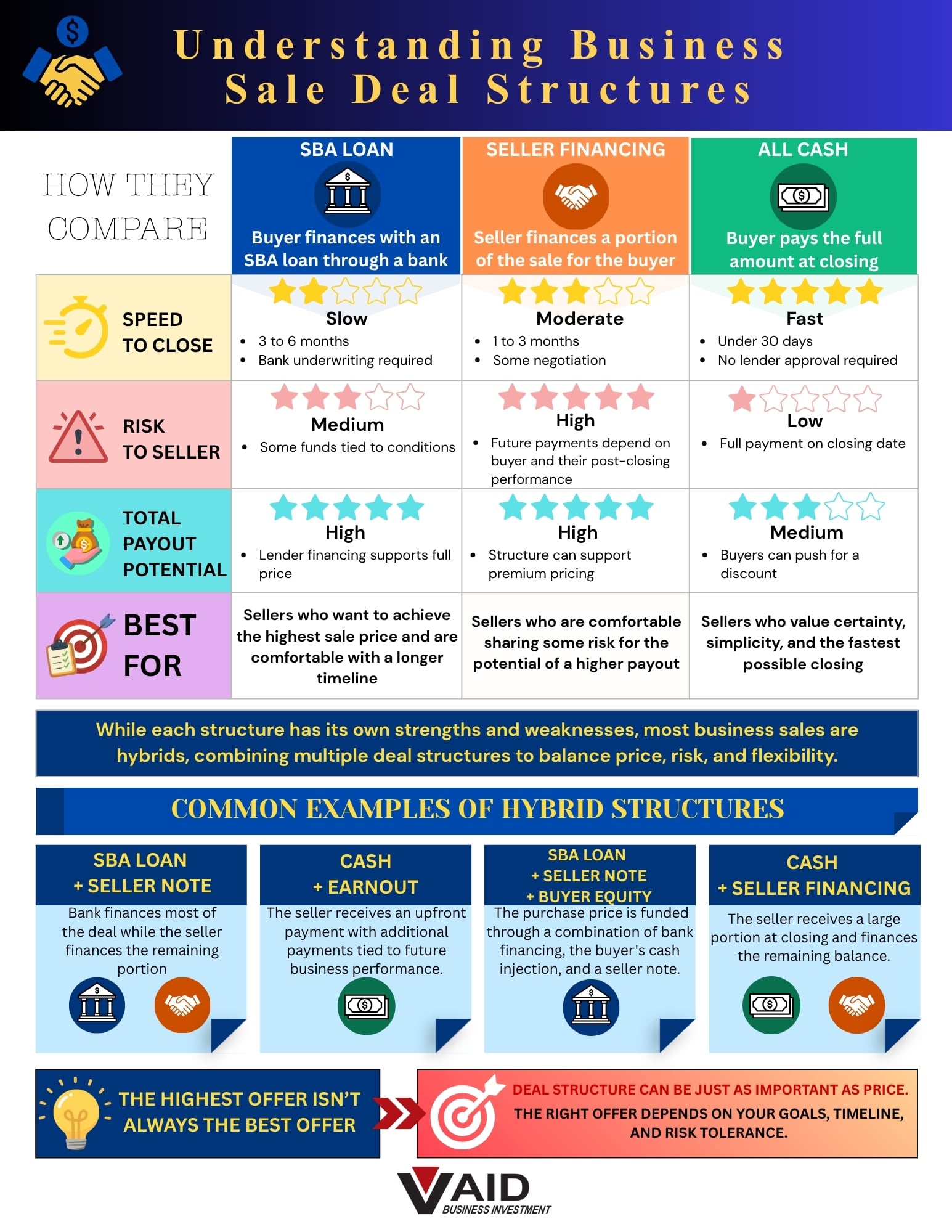
Understanding Business Sale Deal Structures
Business sales can be structured in several ways, with each option offering a different balance of price, speed, and risk. The right structure often depends on the seller’s financial goals and preferred closing timeline.
SBA financed deals can support strong purchase prices but typically require more underwriting and a longer closing process. Seller financing can offer flexibility and potentially higher returns, but it also places more risk on the seller.
All cash transactions generally provide the fastest and most certain closing. However, cash buyers may seek a lower purchase price in exchange for providing sellers with greater speed and certainty.
Many transactions ultimately use a combination of SBA financing, cash, seller notes, or earnouts. The highest offer is not always the best offer, making it important to consider the overall deal structure, timing, and risk in addition to the purchase price.


What Is Seller’s Discretionary Earnings (SDE), and Why Should Business Owners Care?
When business owners begin thinking about selling, one of the first questions they ask is, “What is my business worth?”
Many owners would usually assume that the answer is based on the annual revenue, the amount they’ve invested over the years, or what similar businesses are listed for online. However, in reality, most small businesses are valued very differently.
For the majority of “Main Street Businesses” that are typically purchased by individual buyers or financed through SBA loans, the most important number is Seller’s Discretionary Earnings (SDE). Understanding how SDE works can help business owners set realistic expectations, avoid pricing mistakes, and ultimately sell their business faster and for the highest market-supported value.
What Is Seller’s Discretionary Earnings (SDE)?
Seller’s Discretionary Earnings (SDE) measures the total economic benefit an owner-operator receives from a business Rather than focusing solely on accounting profit, SDE adjusts the company’s financials by adding back certain discretionary, non-recurring, or owner-specific expenses to provide a clearer picture of the cash flow available to a new owner.
It begins with the business’s pre-tax net income and adds back certain expenses that may not continue under new ownership.
Common add-backs include:
- Owner’s salary, payroll taxes, and benefits
- Personal expenses paid through the business
- One-time or unusual expenses
- Interest expense
- Depreciation and amortization
- Non-recurring legal or professional fees
- Other discretionary expenses that would not reasonably transfer to a new owner
The goal of SDE is to show the true earning power of the business for someone who purchases and operates it. Because most Main Street businesses rely heavily on the owner’s day-to-day involvement, SDE is generally the preferred earnings metric used for valuation. Larger lower middle-market businesses, on the other hand, are more commonly evaluated using EBITDA because they tend to have more established management teams and are less dependent on a single owner.
How Is SDE Calculated?
While every business is unique, a simplified calculation looks like this:
Pre-Tax Net Income
+ Owner Compensation
+ Interest
+ Depreciation
+ Amortization
+ Qualified Discretionary or Non-Recurring Expenses
= Seller’s Discretionary Earnings (SDE)
The purpose of these add-backs is to normalize the business’s earnings by removing expenses that may not continue under new ownership. This allows buyers to evaluate the true earning potential of the business rather than the financial decisions of the current owner. However, not every expense qualifies as an add-back.
To be considered, the expense should generally be discretionary, non-recurring, or unique to the current owner. Routine operating expenses (such as payroll for employees, rent, utilities, inventory, insurance, and marketing) typically remain necessary to operate the business and therefore are not added back. Each adjustment should be supported by historical financial records and a reasonable explanation. Buyers, lenders, and appraisers expect these adjustments to be documented rather than based on estimates or verbal statements.
Why Main Street Businesses Are Usually Valued Using SDE
There is no single method for valuing every business. Different industries, company sizes, and transaction types require different valuation approaches.
For most Main Street businesses, buyers are purchasing an owner-operated business that generates income. Because the owner’s involvement often plays a significant role in the business’s success, buyers focus primarily on the cash flow they can reasonably expect to earn after taking over operations.
For that reason, business brokers commonly rely on two primary valuation tools:
- Seller’s Discretionary Earnings (SDE) to determine the business’s normalized cash flow.
- Direct Market Data Method (DMDM) to compare the business against similar businesses that have actually sold.
Similar to a residential real estate appraisal, the Direct Market Data Method analyzes completed sales of comparable businesses, not asking prices, to determine the multiples buyers have actually paid. Factors such as industry, size, profitability, location, growth potential, and risk are all considered when identifying comparable transactions.
When SDE and the Direct Market Data Method are used together, they generally provide the most probable selling price that today’s market is willing to support.
Why Revenue Alone Doesn’t Determine Value
One of the most common misconceptions is that a business is worth a multiple of its annual revenue. While revenue measures how much money a business brings in through sales, it does not show how much the owner actually earns after paying operating expenses. A business with high revenue but low profitability may be worth less than a business with lower revenue and stronger cash flow.
For example:
- Business A generates $2 million in annual revenue but produces only $150,000 in SDE.
- Business B generates $1 million in annual revenue but produces $300,000 in SDE.
Although Business A generates twice the revenue, many buyers would place a higher value on Business B because it produces significantly stronger cash flow.
This illustrates why buyers focus primarily on a business’s earning potential rather than its sales volume. In many cases, a business with lower revenue but higher Seller’s Discretionary Earnings is worth more than a business with substantially higher revenue and lower profitability.
Why the Income Approach is Less Practical for Main Street Businesses
Business owners often hear about valuation methods such as the Income Approach or Discounted Cash Flow (DCF) analysis. While these methods are widely accepted in business valuation, they are generally more appropriate for larger companies with stable financial reporting, professional management teams, and predictable long-term cash flows.
Most Main Street businesses do not fit those characteristics as many are heavily dependent on the owner’s day-to-day involvement, have fluctuating earnings, and experience changes in expenses from year to year. As a result, forecasting future cash flow can be highly subjective, making an income-based valuation less practical for many small businesses.
Instead, buyers, lenders, and business brokers typically place greater emphasis on historical financial performance and actual market transactions. This is why Seller’s Discretionary Earnings (SDE), combined with the Direct Market Data Method (DMDM), is often the preferred approach for valuing owner-operated Main Street businesses, as it reflects both documented earnings and what buyers have actually paid for comparable businesses.
Does Real Estate Affect the Business Valuation?
To answer this question, it depends on if the real estate is leased because the business is typically valued separately from the property. Buyers evaluate the business based on its cash flow while also considering the lease terms, rental rate, remaining lease term, and any renewal options.
If the seller owns the commercial property, there are generally two separate assets involved:
- The operating business
- The commercial real estate
Because these assets generate value in different ways and are often financed separately, each is typically valued independently. Depending on the seller’s goals and the buyer’s financing, the business may be sold with or without the real estate.
When calculating Seller’s Discretionary Earnings (SDE), the business’s rent expense should also reflect fair market value. If the owner is paying themselves above-market or below-market rent, business brokers will often normalize the rent to current market rates. This adjustment helps present a more accurate picture of the business’s earning potential and allows buyers to evaluate the business based on what they can reasonably expect to pay after the sale.
Why Accurate Financial Records Matter
One of the biggest challenges in business valuation occurs when owners estimate their earnings based on memory rather than documented financial records.
Statements like:
- “I usually spend about…”
- “That expense averages around…”
- “I don’t think we spent that much every year.”
are difficult for buyers, lenders, and brokers to rely on because they cannot be independently verified.
An accurate Seller’s Discretionary Earnings (SDE) calculation should be supported by historical financial statements, tax returns, profit and loss statements, payroll records, bank statements, and other supporting documentation. If an expense truly qualifies as an add-back, it should be clearly identified and supported with evidence whenever possible.
Furthermore, business valuations are based on documented financial performance, not verbal estimates or assumptions. Well-organized financial records can increase buyer confidence, simplify due diligence, reduce the likelihood of valuation disputes, and help support a market value that buyers and lenders can justify.
Understanding the Difference Between Perceived Value and Market Value
It is very common for business owners to often develop an emotional connection to the businesses they have spent years building; the time, effort, and sacrifices invested are real, but the market ultimately determines the most probable value based on documented earnings, buyer demand, and perceived risk. In other words, a business is not worth what the owner hopes it is worth, worth what it costs to build, nor is it worth what similar businesses are listed for online. Ultimately, a business is worth what a qualified buyer is willing to pay based on verified financial performance, comparable market transactions, and the level of risk associated with the opportunity.
Understanding Seller’s Discretionary Earnings (SDE) is one of the most important steps in setting realistic expectations and preparing for a successful sale. Owners who understand how buyers evaluate businesses are better positioned to price appropriately, attract qualified buyers, and maximize value during negotiations. Before taking a business into the market, having your financials properly recast and your Seller’s Discretionary Earnings accurately calculated is one of the best investments you can make. Well-prepared financials build buyer confidence, streamline due diligence, and help support a valuation that reflects what the market is truly willing to pay.
Read More