
Who is Buying Small Businesses in 2026
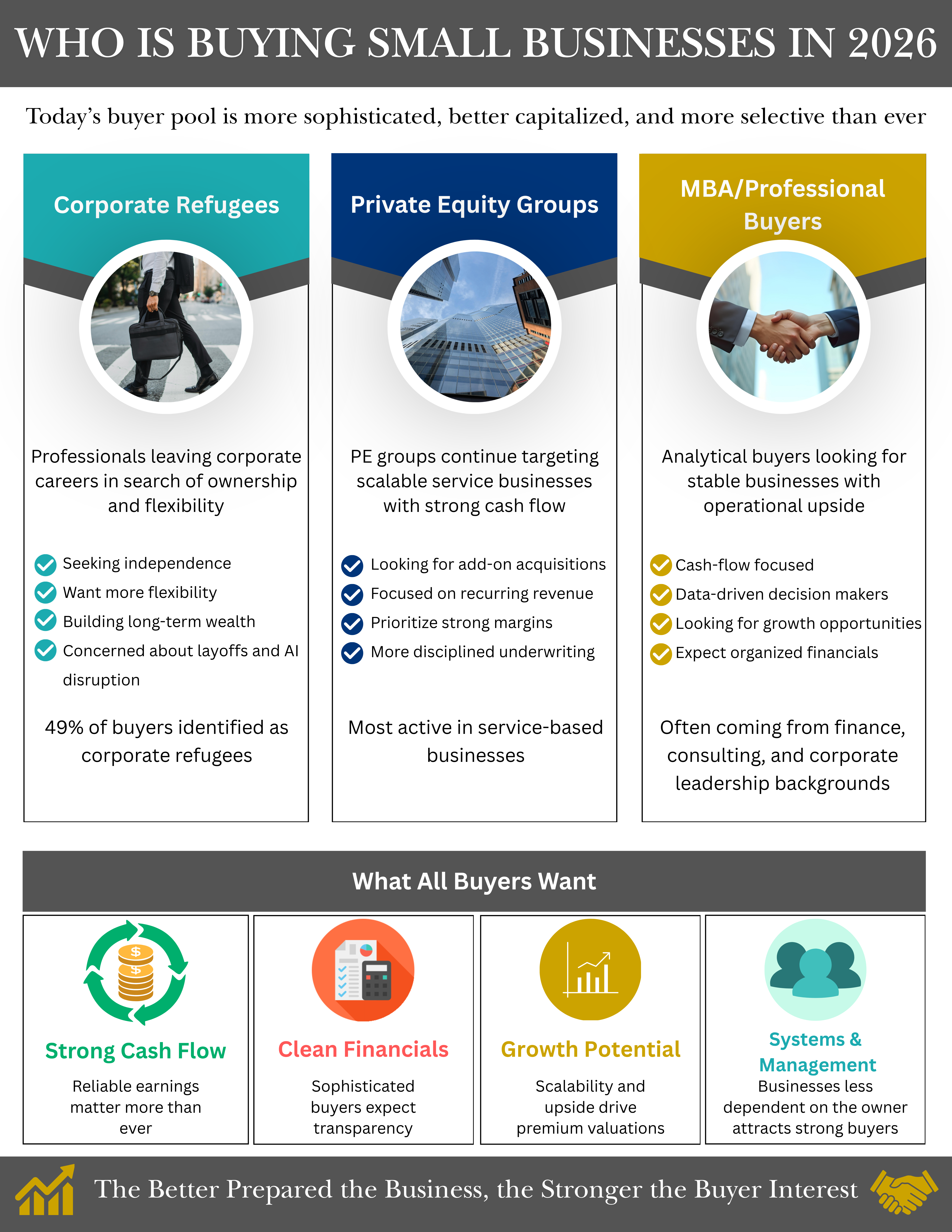
As the small business buyer landscape continues to evolve, today’s buyers are more sophisticated, better capitalized, and more selective than ever before. While individual entrepreneurs remain active in the market, we are seeing increased participation from corporate professionals, private equity groups, and experienced business operators looking to acquire established companies.
Many buyers are leaving traditional corporate careers in pursuit of business ownership, financial independence, and greater flexibility. At the same time, private equity firms and professional buyers continue to target businesses with strong cash flow, scalable operations, and opportunities for growth.
As buyer expectations rise, businesses with clean financials, strong management teams, and clear growth potential are attracting the most interest. Owners considering a future sale should focus on preparing their business today to maximize value and appeal to today’s increasingly sophisticated buyer pool.
Corporate professionals, often referred to as “corporate refugees,” now represent a growing segment of the buyer market. Many are seeking greater control over their careers, additional income streams, or an alternative to the uncertainty of traditional employment. These buyers are often well-educated, financially stable, and willing to invest in businesses with a proven track record.
Private equity groups also remain active, particularly in service-based businesses with recurring revenue and strong profit margins. While these buyers continue to pursue acquisition opportunities, they have become increasingly disciplined in their evaluation process. Businesses with documented systems, reliable financial reporting, and expansion opportunities are often the most attractive acquisition targets.
Overall, regardless of the buyer type, the common factors that consistently drive interest are strong cash flow, transparent financial records, growth opportunities, and businesses that are not heavily dependent on the owner. As the market becomes more competitive and buyers become more selective, business owners who invest time in preparing their company for sale are often rewarded with stronger buyer interest, smoother transactions, and higher valuations.

Why Some Businesses Sell Quickly While Others Sit on the Market
What Makes a Business Easy to Buy and Easy to Sell?
If you’re thinking selling a business in today’s market, one of the most important questions to ask is whether the company is easy for a buyer to acquire. While strong revenue and profitability certainly matter and often help explain why some businesses sell quickly, today’s buyers are looking beyond earnings alone. They want businesses with clean financials, transferable operations, organized records, and financing options that support a smooth transaction.
Today’s business buyers are conducting more due diligence than ever before. Lenders are carefully reviewing financial performance before approving SBA financing, and buyers are scrutinizing every aspect of a business acquisition before making an offer.
As a result, some businesses attract immediate interest and receive multiple offers, while others struggle to gain traction despite producing healthy profits.
The difference, and often the reason why some businesses sell quickly while others sit on the market, often comes down to one simple question:
How easy is the business to buy and, ultimately, how easy is it to sell?
The businesses that attract the strongest buyer interest are often those that reduce uncertainty and make it easy for a buyer to envision a successful transition.
Clean Financials Make a Business Easier to Sell
One of the first things buyers evaluate when considering a business for sale is the financial performance of the company.
Today’s buyers expect detailed and accurate financial reporting. Most will review several years of tax returns, profit and loss statements, balance sheets, payroll reports, and bank statements before moving forward.
When financial records are incomplete, inconsistent, or difficult to understand, buyers become cautious. Questions arise regarding profitability, cash flow, and the overall reliability of the information being presented.
Businesses with clean financials immediately stand out. Clear reporting helps buyers verify earnings and simplifies the due diligence process.
In many cases, organized financial statements not only increase buyer confidence but can also positively influence business valuation because they reduce perceived risk.
Simply put, buyers are more likely to pursue a business acquisition when they trust the numbers.
Why Organized Business Records Matter to Buyers
Financial statements are only one piece of the puzzle.
Buyers increasingly expect organized records throughout the business, including:
-Equipment inventories
-Lease agreements
-Vendor contracts
-Employee documentation
-Customer agreements
-Licenses and permits
-Operating procedures
When records are organized and readily available, buyers can quickly verify information and move through due diligence more efficiently.
On the other hand, transactions often slow down when sellers spend weeks locating documents or attempting to recreate missing information.
Organized records demonstrate professionalism and help create confidence that the business has been managed responsibly.
For owners preparing to sell a business, maintaining accurate records can significantly improve the buyer experience.
Buyers Want Businesses That Can Run Without the Owner
One of the most important questions buyers ask is:
“What happens when the owner leaves?”
Businesses that depend heavily on the owner’s personal involvement often face greater scrutiny during the sale process.
The most attractive businesses have systems and procedures that can be transferred to a new owner.
Examples include:
-Written operating procedures
-Established employee responsibilities
-Consistent customer acquisition methods
-Defined management structures
-Repeatable workflows
When buyers see that a business can continue operating successfully after the owner exits, they feel more comfortable moving forward.
Transferable operations reduce risk and increase the pool of qualified buyers.
In today’s market, businesses that can function independently of the owner are often easier to sell, which is one of the key reasons why some businesses sell quickly while others struggle to attract buyers.
Why Low Owner Dependence Increases Business Value
Many successful businesses are built through years of personal effort and involvement. However, buyers often view excessive owner dependence as a risk.
Common signs of owner dependence include:
-The owner manages all key customer relationships.
-The owner handles every sales function.
-Major decisions require the owner’s approval.
-Critical business knowledge exists only in the owner’s head.
When buyers encounter these situations, they naturally wonder whether revenue and operations will remain stable after the transition.
Businesses with empowered employees, documented processes, and delegated responsibilities typically generate greater confidence among buyers.
Reducing owner dependence is one of the most effective ways to improve both business valuation and marketability.
Why SBA Financing Makes a Business More Attractive
Financing plays a major role in business acquisitions.
Many transactions today involve SBA financing because it allows qualified buyers to purchase a business with less upfront capital.
As a result, businesses that are considered “bankable” often attract a larger pool of buyers.
A business that qualifies for SBA financing typically has:
-Consistent cash flow
-Verifiable earnings
-Stable operating history
-Reasonable debt levels
-Clean financial reporting
When buyers know a business is likely to qualify for an SBA loan, they are often more willing to pursue the opportunity.
Conversely, businesses that cannot obtain financing may require substantially larger cash investments, limiting the number of qualified buyers.
Making a business financeable can dramatically improve buyer interest and increase the likelihood of a successful transaction.
Seller Financing Can Help Close More Deals
Although not every transaction includes seller financing, buyers generally view some level of seller participation positively.
A seller note can demonstrate confidence in the business while helping bridge financing gaps that occasionally arise during negotiations.
In many successful transactions, the seller is willing to carry a modest note for a qualified buyer to help complete the deal.
This flexibility can benefit both parties by making the transaction easier to finance and helping buyers feel more comfortable moving forward.
Seller financing is rarely the primary driver of a sale, but it can often help good deals reach the finish line.
Well-Maintained Assets Create Strong First Impressions
The condition of business assets can significantly influence buyer perception.
Buyers carefully evaluate:
-Equipment
-Furniture and fixtures
-Vehicles
-Technology systems
-Production assets
-Specialized tools
Businesses with assets in good condition generally create a stronger first impression.
Well-maintained equipment signals responsible ownership and reduces concerns about unexpected repair or replacement costs after closing.
While buyers understand that no asset remains brand new forever, they appreciate businesses that have consistently invested in maintenance and upkeep.
A business with clean, functional assets is often easier to market and easier to sell.
Modest Transition Support Reduces Buyer Risk
Many buyers, particularly first-time business owners, are concerned about the transition period following a sale.
This is why modest post-transaction support can make a business significantly more attractive.
Buyers appreciate sellers who are willing to provide reasonable training and consultation after closing.
This support may include:
-Employee introductions
-Customer introductions
-Vendor transitions
-Operational training
-General consultation during the transition period
Most buyers are not seeking long-term involvement from the seller. They simply want reassurance that guidance will be available during the initial ownership transition.
A willingness to provide post-sale support often increases buyer confidence and helps transactions close more smoothly.
Realistic Seller Expectations Help Businesses Sell Faster
One of the most overlooked factors in selling a business is the seller’s mindset.
Buyers appreciate working with sellers who understand market conditions and approach negotiations realistically.
Being realistic does not mean accepting an unreasonable offer. It means recognizing that business acquisitions involve financing requirements, due diligence, negotiation, and compromise.
Sellers who remain flexible and responsive often achieve better outcomes than those who focus exclusively on a specific purchase price.
The strongest transactions occur when both parties are committed to finding a structure that works for everyone involved.
Final Thoughts: Making a Business Easier to Sell
A business does not need to be perfect to attract serious buyers.
However, businesses that are easy to understand, finance, and transition consistently generate stronger buyer interest.
If a business owner is considering a sale in the next few years, focusing on the factors buyers care about most can significantly improve marketability:
-Clean financials
-Organized records
-Transferable operations
-Low owner dependence
-SBA financing eligibility
-Flexible deal structures
-Well-maintained assets
-Reasonable transition support
-Realistic seller expectations
The businesses that receive the strongest offers are not always the fastest growing. More often, they are the businesses that reduce uncertainty, inspire confidence, and make it easier for buyers to envision a successful transition.
By preparing well before going to market, owners can increase buyer interest, improve valuation, and position themselves for a smoother and more successful sale.
Frequently Asked Questions as to Why Some Businesses Sell Quickly
What makes a business easier to sell?
Businesses with clean financials, organized records, strong cash flow, transferable operations, and low owner dependence are generally easier to sell because buyers can more easily evaluate and finance the opportunity.
Does SBA financing help sell a business?
Yes. Businesses that qualify for SBA financing often attract a larger pool of buyers because purchasers can finance a portion of the acquisition rather than paying entirely in cash.
Why do buyers care about owner dependence?
Buyers want confidence that the business will continue performing after the seller exits. Excessive owner dependence increases risk and can negatively impact buyer interest and valuation.
Does a seller need to offer financing?
No. However, a seller willing to carry a modest note for a qualified buyer can often help facilitate a transaction and increase buyer confidence.
How important are financial records when selling a business?
Financial records are one of the most important aspects of any transaction. Clean, organized financial statements help buyers verify earnings and complete due diligence more efficiently.
What role does post-sale training play in a business sale?
Post-sale training and consultation help ensure a smooth transition, reduce buyer risk, and can make a business more attractive to prospective purchasers.
Read More

Buying a Distressed Business: 4 Reasons Why It Can Work (and Why It’s Not for Everyone)
It’s no surprise within the business for sale market, most buyers walk away from struggling businesses. They see risk, uncertainty, and too many problems to fix.
But experienced buyers often see something else, they see opportunity.
A distressed business is not just a failing company. In many cases, it is a business with real assets, existing customers, and a place in the market, but one that has been poorly managed, neglected, or hit by temporary challenges.
That difference matters.
For the right buyer, buying a distressed business can be a chance to acquire something valuable at a lower price and improve it over time. But this approach requires more than optimism. It takes experience, clear thinking, and the financial ability to handle setbacks along the way.
This is not a beginner strategy. But for those who are prepared, it can be a powerful one.
1. Lower Purchase Price with Real Assets Already in Place
One of the biggest advantages of buying a distressed business is the price.
When a business is underperforming, owners are often motivated to sell. They may be dealing with financial pressure, burnout, or frustration after trying to fix ongoing issues. Because of this, the asking price is often lower than what the business could be worth if it were running properly.
What you are buying is not just current performance, but underlying value.
That value can include:
-Equipment and physical assets
-Existing customers or contracts
-Brand recognition in the local market
-A location that is already set up for operations
-Basic systems and processes, even if they need improvement
For many buyers, this can be more cost-effective than starting from scratch. Opening a new business often requires significant upfront investment before generating any revenue. In contrast, buying a distressed business may already have the foundation in place.
However, it is important to understand that a lower price does not mean a lower total investment. The purchase price is only part of the equation. You should also expect to invest time and money into fixing what is not working.
The real opportunity lies in the gap between what the business is today and what it could become with better execution.
2. Less Competition Creates Better Buying Conditions
In most markets, strong businesses attract the most attention. Buyers compete for companies with steady revenue, clean financials, and predictable performance. These deals often receive multiple offers, which can drive up prices and make it harder for buyers to stand out.
Distressed businesses tend to sit on the other side of that dynamic.
Because they come with uncertainty, many buyers choose to avoid them entirely. This naturally reduces competition. Fewer buyers means fewer bidding situations and less pressure to rush into a decision.
This can create a more favorable environment for thoughtful buyers.
With less competition, you may have:
-More time to review financials and operations
-Greater ability to ask questions and verify information
-More flexibility in negotiating terms
-A better chance of structuring a deal that works for both sides
In some cases, sellers are also more open to creative solutions, especially if they are eager to move on. This might include flexible payment terms or transition support.
That said, less competition does not automatically mean a good deal. The lack of interest from other buyers could be a sign that there are real issues to understand and address.
The advantage comes from being willing and able to evaluate those issues clearly, not from ignoring them.
3. You Are Stepping Into an Existing Business, Not Starting From Zero
Starting a business from scratch can be expensive, time-consuming, and uncertain. It can take months, or even years, to build customers, hire a team, and generate steady revenue. A distressed business is different because it is already operating.
Even if performance is weak, there is usually some level of activity in place. Most distressed businesses already have:
-Customers who are still buying
-Employees who understand day-to-day operations
-Supplier and vendor relationships
-A physical location or online presence
-Existing workflows (even if they need improvement)
This gives you a real starting point. Instead of building everything from zero, your focus shifts to improving what is already there.
In many cases, relatively small changes can make a noticeable impact, such as:
-Improving scheduling and staff efficiency
-Reducing waste or unnecessary expenses
-Tightening cost controls
-Adjusting pricing
– Improving customer service
However, it is important to be realistic. Not every business has a strong foundation. Some may have lost key customers, developed a damaged reputation, or accumulated internal and operational issues that take time to correct. The key is determining whether the business is something a buyer can build on or something that requires significant rebuilding.
This is where the real opportunity comes in. Many distressed businesses are not failing because there is no demand; they are struggling because of how they are being run. Issues such as poor marketing, inefficient operations, weak financial controls, inconsistent service or product quality, and lack of leadership are common. These are often fixable with the right approach.
For example, a business with an absentee owner may underperform simply because no one is paying close attention to daily operations. A hands-on owner can introduce structure, accountability, and consistency, which can lead to immediate improvements without changing the core business.
The goal is not to reinvent the business, but to clearly identify what is not working, focus on the highest-impact improvements, and strengthen execution step by step. Experience plays a critical role in this process. Knowing what to prioritize, how to manage people effectively, and how to make decisions under pressure can significantly influence the outcome. Without that experience, it is easy to spend time and resources on the wrong changes while the underlying problems remain unresolved.
4. Successful Turnarounds Can Lead to Significant Value Growth
When a distressed business is improved successfully, the increase in value can be meaningful.
A business that was once underperforming can become stable, profitable, and more attractive to future buyers. This creates several potential paths forward:
-Continue operating the business for steady income
-Sell the business at a higher valuation
-Expand by acquiring additional businesses
For some investors and operators, this is a repeatable strategy. They focus on identifying underperforming businesses, improving them over time, and then realizing the value they have created.
However, it is important to understand that this outcome is not guaranteed. Turnarounds take time, and results are not always predictable.
The value is created through consistent effort, disciplined decision-making, and the ability to adapt when things do not go as planned.
A Word of Caution: The Risks Are Real
While the potential benefits of buying a distressed business are clear, it is important to be direct about the risks involved. In most cases, this type of acquisition is not a good fit for first-time buyers. Although the lower purchase price can be appealing, distressed businesses are often more complex and difficult to fix than they initially appear. Instead of learning how to run a business step by step, the buyer is stepping into a situation where multiple problems must be addressed at the same time.
These challenges can include unstable or declining revenue, disorganized operations, employee turnover or low morale, loss of customers, or even a damaged reputation. In some cases, there may also be hidden liabilities or incomplete financial information, which can make it harder for the buyer to fully understand the true condition of the business. One of the most critical aspects of any turnaround is knowing what to fix first. If the buyer focuses on the wrong issues, time and resources can be wasted while the business continues to struggle.
Financial risk is another major factor to consider. Many distressed businesses require more capital than expected, and the buyer should be prepared for additional working capital needs, unexpected expenses, delays in reaching profitability, and even periods with little or no income. Without a financial cushion, even small setbacks can turn into serious problems.
There are situations where a distressed business can work for a first-time buyer, but they are less common. It may make sense if the buyer has strong experience in the industry, solid operational or problem-solving skills, access to additional capital, and support from experienced partners or advisors. Even in these cases, success depends on having a clear and realistic plan in place before completing the purchase.
Final Thoughts
Buying a distressed business is not about taking reckless risks. It is about understanding a situation clearly and making informed decisions.
These opportunities exist because most buyers choose to avoid them. That is what creates the potential for value, but it is also what creates the risk.
For experienced buyers with the right skills and financial resources, distressed businesses can offer a path to acquire undervalued assets and improve them over time.
For others, a more stable business may be a better starting point.
As with any business opportunity, the key is knowing where you stand, what you are capable of handling, and whether the opportunity in front of you truly makes sense.
Read More
Why Selling a Business Still Needs More Than AI
Artificial intelligence has made it easier than ever for business owners to access information. In just minutes, you can generate an estimated business value, review the selling process, or even draft marketing materials. These tools can be helpful for early research, organization, and general preparation.
However, selling a business involves much more than gathering information. Most owners go through this process only once, while many buyers, especially investors and experienced operators, have completed multiple transactions. That difference in experience can shape negotiations, influence deal structure, and affect how smoothly the process moves from listing to closing.
Every business sale is unique. Market conditions, industry trends, financial performance, buyer demand, and personal goals all play a role. While AI can provide useful data, achieving the best outcome usually requires experience, strategy, and hands-on guidance. Understanding where technology helps and where professional expertise adds value is key to navigating a successful sale.
The Numbers Don’t Tell the Whole Story
Financial performance is one of the biggest drivers of business value, but numbers alone rarely tell the full story. Financial statements provide a snapshot of past performance, yet buyers also consider future potential, stability, customer trends, management depth, and overall risk. That’s why two businesses with similar cash flow can sell for very different prices.
AI can summarize financial data quickly, but it often lacks the context needed to interpret it correctly. It may not fully capture how the business operates day to day, why certain expenses exist, or how specific market factors influence value. Without that deeper understanding, important details can be overlooked.
An experienced business broker knows how to analyze financials beyond the surface. They can identify appropriate addbacks, adjust for unusual or one-time expenses, and account for ongoing costs or risks that buyers will evaluate carefully. This leads to a more realistic valuation and helps present the business in a way that reflects its true strengths.
Once value is understood, the next step is turning that value into an actual sale and that’s where negotiation and deal structure become critical.
AI Can Estimate Value But It Can’t Negotiate Your Deal
AI tools and online calculators can provide a rough estimate of what a business might be worth, but that estimate doesn’t determine the final sale price. What a business ultimately sells for often depends on how the deal is structured, whether seller financing is involved, SBA lending requirements, transition support, contingencies, and the qualifications of the buyer.
Small adjustments in structure can make a big difference. Offering reasonable financing terms can attract more buyers. A clear transition plan can reduce perceived risk. Flexibility during negotiations can help keep a deal moving when unexpected issues arise.
Most business sales encounter some level of friction. Financing delays, lender documentation requests, or shifting buyer priorities are common. Managing these moments requires experience, clear communication, and steady guidance. While AI can suggest strategies, it cannot actively manage negotiations, maintain deal momentum, or balance the human dynamics involved.
Beyond negotiations, understanding the broader market environment also plays a major role in a successful sale.
What AI Doesn’t Know About Your Local Market
Every market is different. Buyer demand varies by region, industry, and economic conditions. Some sectors may be in high demand locally, while others move more slowly depending on demographics, financing availability, or competition.
AI relies largely on broad datasets and general trends. It often lacks real-time visibility into local activity, such as:
-Which buyers are actively looking right now
-What local lenders are currently approving
-How similar businesses nearby are performing on the market
-What comparable businesses are actually selling for after negotiations
Relationships also matter more than many owners realize. Experienced brokers often maintain networks of qualified buyers, lenders, attorneys, and advisors who can help move deals forward efficiently. Exposure alone isn’t enough, reaching the right buyers at the right time can make all the difference.
Without that market insight and network, some owners attempt to handle the process themselves, which can introduce additional risks.
The Hidden Risks of a DIY Sale in the AI Era
Technology has made it easier than ever to attempt a private sale. While that may seem appealing, many owners underestimate the risks involved.
Confidentiality is one of the biggest concerns. If employees, customers, vendors, or competitors learn about a potential sale too early, it can disrupt operations and affect business value.
Screening buyers is another challenge. Not everyone expressing interest is qualified or serious. Time spent with unprepared buyers can distract from running the business and slow the sales process.
There are also legal, financial, and procedural details that require careful handling. Deals that aren’t structured properly can collapse late in the process, sometimes making future sale attempts more difficult.
A professional business broker helps manage these risks by:
-Keeping inquiries confidential and controlled
-Vetting buyers for financial ability and seriousness
-Structuring deals to reduce risk
-Coordinating with lenders, attorneys, and advisors
-Keeping the process organized and on track
This level of oversight helps protect both the business and the seller while improving the chances of a successful closing.
Use AI to Prepare, Not Replace Professional Guidance
AI can be a valuable resource when preparing to sell a business. It can help you learn the basics, organize financial information, understand terminology, and explore possible valuation ranges. Used this way, technology can make you more informed and confident going into the process.
But selling a business ultimately involves strategy, negotiation, timing, market awareness, confidentiality, and real-time decision-making. These are areas where experience and a professional selling guide still make a meaningful difference.
If you’re considering selling your business, AI can be a helpful starting point, but working with an experienced business broker can help you navigate the process more smoothly, protect your interests, and maximize the final outcome. A professional consultation is often the smartest first step toward a successful sale.
Read More