


Asset Sale vs. Stock Sale: Key Differences Every Business Owner Should Know
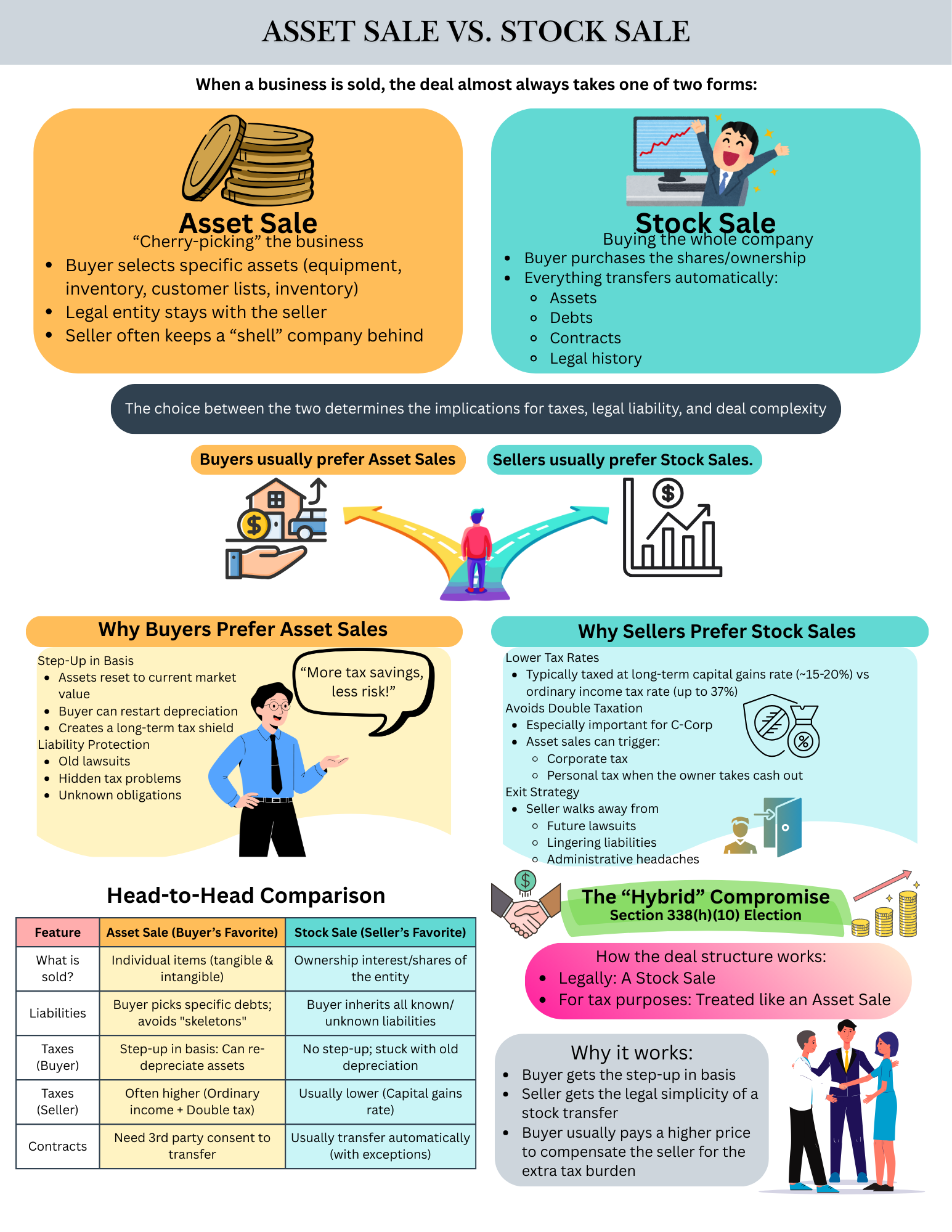
When a business is sold, the transaction is almost always structured as either an asset sale or a stock sale. While the distinction may sound technical, the structure of the deal has major implications for taxes, legal risk, and how smoothly ownership transfers. In most transactions, buyers lean toward asset sales, while sellers typically prefer stock sales.
In an asset sale, the buyer purchases selected pieces of the business, such as equipment, inventory, customer lists, or intellectual property, rather than the company itself. The legal entity remains with the seller, often holding any leftover liabilities. In a stock sale, the buyer purchases the ownership interests of the company, meaning everything inside the entity transfers automatically, including assets, contracts, debts, and legal history.
Buyers generally favor asset sales because they offer greater protection and tax advantages. Purchasing assets allows buyers to “step up” the value of those assets for tax purposes, enabling new depreciation schedules that can reduce taxable income over time. Asset sales also allow buyers to leave behind unwanted liabilities, minimizing exposure to unknown risks.
Sellers, on the other hand, usually prefer stock sales because they are simpler and often more tax-efficient. Stock sales are typically taxed at long-term capital gains rates and can help sellers avoid double taxation, especially in C-corporation deals. Just as importantly, a stock sale allows the seller to make a clean exit, walking away from the entity and its future obligations.
In some cases, buyers and sellers compromise using a Section 338(h)(10) election, which treats the transaction as a stock sale legally but an asset sale for tax purposes. This structure gives buyers the tax benefits they want while preserving the simplicity of a stock transfer, often with a higher purchase price to balance the tax impact for the seller.

Selling Your Business? 7 Common Value Slashers
The Silent Threat to Business Owners
Most business owners think their company’s value is based mainly on revenue, profit, or how busy the business looks from the outside. But what really hurts value usually isn’t obvious on a financial statement. It hides in the way the business is run, how dependent it is on the owner, how organized (or disorganized) operations are, and how much risk sits quietly inside the company. Those issues often don’t cause daily problems, so they’re easy to ignore, until a buyer, bank, or investor starts digging.
That’s when many owners discover the truth: value isn’t usually lost in one big moment. It slowly slips away because of problems that felt “under control” for years.
In this article, we’ll break down seven common hidden value slashers most businesses have, why they matter, and what you can do to fix them before they cost you real money.
The 7 Value Slashers When Selling Your Business
#1 Owner Dependency: When the Business Can’t Breathe Without You
One of the biggest hidden threats to valuation is when the business is overly dependent on the owner. If the company can’t function when you take a vacation… if every customer insists on speaking only with you… if every decision has to cross your desk… congratulations, you haven’t just built a business, you’ve built a job you own.
Buyers don’t want to purchase someone else’s workload. They want to acquire an operation that runs predictably, consistently, and profitably without being tethered to one individual. When success is tied directly to your presence, expertise, or relationships, a buyer sees risk… and risk always reduces price, leverage, and deal structure.
The warning signs often feel like compliments:
“You’re the only one who really understands the business.”
“Nothing moves forward unless you approve it.”
“Our customers trust you more than anyone else.”
Those statements sound flattering, but they’re actually indicators that the business does not stand on its own. In due diligence, that doesn’t translate to admiration, it translates to uncertainty, transition concerns, and fear of revenue loss once you exit.
The Fix: Start building a business that can operate without you. That means developing real leadership depth, delegating decision-making authority (not just tasks) and investing in training and documented processes.
Encourage client relationships with your team, not just with you. Create a culture where you are no longer the single point of failure.
The goal is simple: if you step back, the business shouldn’t slow to a crawl… it should continue to perform. When an owner becomes optional rather than essential, valuation increases, confidence rises, and your business becomes the readily transferable, high-value asset it was meant to be.
#2 Limited Operating History: When Success Is Too New to Trust
A business can look and feel exciting when it’s growing fast, but if it hasn’t been around long enough to prove consistency, buyers get cautious. Newly established businesses, or companies with only a short window of strong performance for less than three years, often struggle to justify premium valuations simply because there isn’t enough historical data to prove the results are sustainable.
Buyers aren’t just purchasing today’s success, they’re trying to predict tomorrow’s reliability. Without a track record, that prediction becomes guesswork, and guesswork lowers price.
You’ll also recognize this situation if: your business has only been profitable for a short period, is still stabilizing revenue, recently pivoted its model, or simply hasn’t existed long enough to show multi-year proof of performance. Maybe the growth is real and momentum is strong, but there aren’t enough years of financial statements to demonstrate that it’s durable. From an owner’s perspective, it may feel obvious that success will continue. From a buyer’s perspective, it feels untested.
The Fix: Focus on building credibility and clarity. Maintain clean, accurate, professionally prepared financials from day one. Show consistent month-over-month and year-over-year improvement. Build recurring revenue where possible. Strengthen customer retention and operational stability.
Document why your success is sustainable and not accidental or short-lived. The more predictable and proven your performance becomes, the easier it is for buyers to feel confident… and the higher your valuation climbs.
#3 Messy or Unreliable Financials: When “Good Enough” Becomes Very Expensive
Nothing kills confidence faster in a deal than financials that are unclear, inconsistent, or undocumented. You may know your business is healthy, profitable, and stable, but buyers don’t purchase based on trust; they purchase based on proof.
When your books are disorganized, loads of personal expenses are mixed in, add-backs are questionable, or financial statements don’t align, what feels like “normal” to you looks like risk to a buyer. And in valuation, risk is punished every single time. Deals slow down, legal and accounting costs go up, and more often than not, the purchase price drops or the buyer walks away entirely.
If any of this sounds familiar, you’re not alone: the CPA scrambles at tax time because things haven’t been reconciled, cash flow is “managed from the bank account,” financial reports are months behind, or there’s no consistent narrative explaining performance year over year. Owners sometimes think these issues are “just paperwork.” They’re not.
They are the backbone of credibility. Buyers want to see clear earnings, quality cash flow, and financial discipline. When the numbers don’t tell a clean and verifiable story, buyers assume the worst, even if the business is actually performing well.
The Fix: Clean, professional financials are one of the fastest ways to retain business value. Invest in strong bookkeeping and accounting support. Produce timely monthly financial statements. Separate personal and business expenses. Understand what truly qualifies as an add-back. Build 2–3 years of reliable, well-documented financial history.
In short, make your financials defensible. When buyers see clarity, discipline, and transparency, confidence rises… and so does the price they’re willing to pay.
#4 Customer Concentration: When Too Much Revenue Rests on Too Few Relationships
Customer concentration is one of those value slashers that doesn’t feel like a problem until it becomes one. On the surface, having a small number of high-paying clients can feel like efficiency, stability, and partnership. But from a buyer’s perspective, it’s a flashing red warning light.
When 20%, 30%, or even 50%+ of your revenue comes from one or two key accounts, the buyer isn’t just purchasing your business… they’re essentially gambling on whether those clients will stay after you leave. If they don’t, the business they just bought could collapse overnight. That level of dependency turns what could have been a strong valuation into a discounted, heavily structured, or risky deal very quickly.
The tough reality: if one client has the power to significantly affect your financial health by leaving, renegotiating, or reducing spending, then your business doesn’t truly control its revenue, your client does. Buyers know this. Lenders know this. And in due diligence, they scrutinize it hard.
Even if that anchor client has been loyal for years, even if the relationship feels “rock solid,” buyers think in terms of risk probability, not optimism. High concentration equals uncertainty. Uncertainty equals lower prices, more earn-outs, and tougher negotiations.
The Fix: Diversification is key. Start intentionally widening your customer base so no single client holds your business hostage. Develop a strategy to attract mid-tier accounts rather than depending solely on whales. Where possible, strengthen contracts, extend terms, or create recurring revenue arrangements that lock in stability.
Going to our first value slasher, cultivate deeper client relationships across your organization so loyalty isn’t tied to you personally. Over time, aim for no single customer representing more than 10–20% of total revenue. When your revenue is spread across many reliable customers, your business instantly becomes more resilient, more transferable, and far more valuable in the eyes of a buyer.
#5 Weak or Inconsistent Profit Margins: When Busy Doesn’t Equal Valuable
A surprising number of businesses look strong on the surface; steady revenue full workloads, phones ringing, yet when you peel back the layers, the margins tell a very different story. Buyers don’t pay for how busy the business is; they pay for how profitably the business operates.
Thin or inconsistent margins signal fragility. They suggest pricing pressure, operational inefficiency, poor cost control, or a business that must run at full throttle just to survive.
When a buyer sees that profitability disappears the moment volume dips or costs rise, they see risk. And once again, risk pushes valuation down.
Here’s where many owners get caught: they chase revenue because it feels like growth. They discount to win deals. They take on unprofitable customers “for the relationship.” They maintain outdated pricing while costs quietly rise. Over time, the business becomes addicted to volume instead of disciplined around value.
During due diligence, buyers will analyze not just your revenue, but your quality of earnings, your consistency, pricing power, and resilience. If your margins wobble year to year or barely hold together, they’ll either demand a lower price, insist on heavy contingency structures, or move on to a stronger, more stable acquisition.
The Fix: Start treating margins like a strategic priority, not an afterthought. Conduct a pricing review and ensure your rates reflect current costs, labor realities, and market positioning.
Identify unprofitable products, services, or customers, and either fix them or phase them out. Tighten operational efficiencies, reduce waste, and hold the team accountable to margin targets, not just top-line goals.
Strong, predictable margins tell buyers your business is disciplined, healthy, and capable of generating dependable returns. That confidence turns into higher offers, better deal terms, and protected value.
#6 Lack of Systems, Processes, and Documentation: When Success Depends on “How We’ve Always Done It”
One of the quietest yet most damaging value slashers is a business that runs on memory, habit, and tribal knowledge instead of documented systems. Many companies grow on grit, hustle, and experience, especially founder-led companies. That works… until it doesn’t.
From a buyer’s perspective, a business without standardized processes is unpredictable. It means performance relies on individual people, not proven systems. And anything that feels unpredictable lowers confidence, complicates transition, and potentially reduces value.
You’ll recognize this problem if any of these sounds familiar:
Employees train new hires by “shadowing.” Tasks are done based on “how Susan likes it done.” The answer to most operational questions starts with, “It depends…”
Procedures live in people’s heads instead of anywhere accessible. The business functions, but it does so informally. That might feel normal day to day, but to a buyer, it looks like a house held together by experience instead of structure.
If a key person leaves, or if the buyer takes over without your team’s full support, performance can drop quickly. That risk shows up as price reductions, extended earn-outs, and hesitation.
The Fix: Turn your business into a machine rather than a personality-driven operation. Start by documenting core processes: sales workflows, service delivery, customer onboarding, financial procedures, and daily operational routines. Create SOPs (standard operating procedures) that are clear, repeatable, and accessible. Introduce technology where it creates efficiency, consistency, and visibility. Build training systems that don’t depend on one person doing all the teaching.
When your business can show buyers well-documented workflows and predictable execution, it sends a powerful message: “This company doesn’t just operate, this company knows how it operates.” And that instantly increases trust, transferability, and value.
#7 No Strategic Positioning or Differentiation: When You Look Like Everyone Else When Selling Your Business
The final hidden value slasher is one many owners never notice because it hides in plain sight: lack of differentiation. If your business sounds like every other competitor in your industry standing out with “great service,” “quality work,” “competitive pricing”, then from a buyer’s perspective, you’re a commodity.
Commodities don’t command premium valuations. When there’s nothing distinct about your offering, brand position, expertise, market niche, or customer experience, buyers assume the only level your business truly competes on is price. That means thinner margins, less loyalty, and a business that’s easier for competitors to replicate, all of which drag value down.
Here’s the uncomfortable truth: if your business disappears tomorrow, and your customers could easily replace you with another provider without much disruption, then you don’t own a strong market position, you just occupy space in it.
Buyers want companies with an edge: a brand people recognize, a niche where they dominate, intellectual property or proprietary methods, a reputation that commands respect, or a clearly defined specialty that makes them harder to replace. When none of that is present, the business may operate fine, but it doesn’t stand out, and that shows up directly in valuation.
The Fix: Get intentional about positioning. Clarify what you do better than anyone else and lean into it.
Define your specialty. Strengthen your brand presence and reputation.
Become known for something specific rather than trying to be everything to everyone. Build credibility through testimonials, case studies, market authority, and consistent messaging. Explore ways to create defensibility, recurring revenue programs, proprietary processes, exclusive relationships, or specialized expertise.
When a buyer can clearly answer the question, “What makes this business different and hard to replace?”, your perceived value increases dramatically. And that’s when your business stops being just another option and starts being a premium acquisition.
Value Doesn’t Vanish Overnight, It Slips Away Quietly
The most dangerous part about these seven value slashers is that none of them feel urgent while you’re running the business. The doors are open, customers are happy enough, revenue is coming in, and operations mostly work. That’s why so many owners are blindsided later.
These issues don’t show up as emergencies; they show up as lost valuation, tougher negotiations, demanding buyers, drawn-out due diligence, or deals that collapse right when the finish line is in sight. Value isn’t lost in dramatic moments, it erodes slowly, through risks that feel manageable… until someone else is evaluating your company from the outside.
The good news is every single one of these problems is fixable with clarity, discipline, and intention. Strengthen leadership. Clean up financials. Reduce dependency on you, on a few employees, or a handful of customers.
Build processes. Define your positioning. Treat your business like the asset it truly is, not just something you operate day-to-day. Whether you plan to sell in two years, ten years, or never, addressing these value slashers will give you more options, more leverage, and a stronger, more resilient company.
The best time to prepare was years ago.
The second-best time is right now.
Read More
Red Flags When Buying a Business: Why Due Diligence Matters
Red flags when buying a business are not always immediately obvious, but spotting them early is essential to making a smart purchase. Buying an existing business can be one of the fastest ways to step into ownership with an established brand, customer base, and cash flow.
However, even the best opportunities can have hidden problems. These issues can threaten long-term success. Without a careful due diligence process, buyers risk taking on financial, legal, or operational issues. These problems can quickly turn a good deal into a costly mistake.
Identifying potential red flags early protects your investment. It also gives you leverage to negotiate better terms or walk away before it’s too late. Here are some of the most common red flags every business buyer should watch for during a business sale.
Financial Statements: Key Warning Signs to Watch
One of the first places to look for red flags is in the financial statements. Numbers tell a story, and if that story doesn’t make sense, it’s often a sign of deeper issues. Missing or inconsistent financial records, like incomplete bookkeeping or unaudited statements, can show poor management. They may also suggest attempts to hide problems.
Falling revenue or smaller profit margins may show lost customers, market changes, or costly inefficiencies that need fixing. Likewise, unexplained expenses or erratic cash flow patterns are warning signs that deserve close scrutiny.
And while future projections can be helpful, they should be grounded in reality, not optimism. Before moving forward, it’s smart to have a qualified CPA check the company’s financials. This will ensure the numbers are correct.
Owner and Client Dependence: Risks of Over-Reliance
Another major red flag to watch for is a business that’s overly dependent on the current owner or a handful of key clients. When the owner handles customer relationships and daily operations, the business can have problems if they leave. If a large part of revenue comes from one or two big clients, losing one could greatly hurt profits.
Not having clear systems or standard processes increases the risk. This makes it hard for a new owner to keep things running smoothly. To address these challenges, buyers should ask for a clear transition plan. If possible, they should negotiate a seller stay-on period. This will help ensure a smooth handover of relationships and operational knowledge.
Legal and Compliance Issues: Avoiding Hidden Liabilities
Legal and compliance issues are another critical area that can expose buyers to significant risk if overlooked. Pending lawsuits, customer disputes, or employee claims can quickly turn into costly liabilities once ownership changes hands. It’s important to check that all business licenses and permits are up to date and transferable. If they are not, it can disrupt operations or stop business activities completely.
It’s important to follow industry regulations, especially in healthcare, finance, food, and construction. Violating these rules can lead to high fines or harm to your reputation. Additionally, environmental or zoning concerns can lead to unexpected expenses or legal complications down the road. To protect your investment, it is wise to have a qualified attorney review all contracts and legal documents. This should be done before you finalize the purchase.
Operational Inefficiencies and Hidden Costs
Operational inefficiencies and hidden costs can quietly erode profitability and create major challenges for new owners. Some of these issues are not easy to see. However, they can greatly affect the business’s money health and how well it runs. Key areas to watch include:
· Outdated systems, equipment, or technology: May require immediate investment just to remain competitive, leading to unplanned expenses.
· High employee turnover: Could indicate management or cultural problems that disrupt productivity and customer relationships.
· Inflated inventory or excessive supplier costs: Might signal poor purchasing controls or obsolete stock that may need to be written off.
· Hidden obligations: Maintenance costs, unfavorable leases, or undisclosed debt can strain cash flow and reduce the business’s true value.
To find these challenges, buyers should ask for an operational audit. This will help them understand daily operations and possible problems before making a purchase.
Red Flags When Buying a Business Can Be Avoided
Spotting red flags when buying a business doesn’t mean you should walk away from every deal. It’s about making smart and confident choices. The key is to spot potential risks early. This way, you can negotiate from a strong position. You can also invest in a business with long-term potential. Taking a cautious, professional approach with the guidance of experienced advisors such as business brokers, accountants, and attorneys can make all the difference in avoiding costly surprises after closing.
At V-AID Group, we are a top business brokerage in the DFW area. Since 2001, we have focused on selling privately held companies. We work with small to lower middle market businesses. These are also called Main Street and lower mid-size businesses. Their selling prices range from $250,000 to $25 million. We conduct thorough due diligence prior to listing businesses and ensure that all necessary documents are provided, allowing prospective buyers to complete a comprehensive review of financials, operations, and legal compliance.
By giving clear and accurate information, we create a transparent process. This helps people make informed decisions and ensures smooth transactions. If you are thinking about buying a business, contact V-AID Group today. We can help you use our experience and guidance. This will make sure your next purchase is smart, safe, and profitable.
Read MoreIs Now a Good Time to Sell My Business? Why Timing the Market is a Bad Idea
If you’re a business owner thinking about selling, you’ve probably asked yourself: “Is now a good time to sell my business?” With headlines constantly shifting, interest rates rising, economic uncertainty looming, it’s easy to convince yourself to wait for “better” conditions. But here’s the reality: waiting for the perfect market often means waiting forever. Much like trying to time the stock market, trying to predict the exact right moment to sell your business is a gamble. And more often than not, it leads to missed opportunities, stalled plans, and lost value. Instead of obsessing over market conditions, the more important question is: Are YOU and your business ready to sell?
Why the Perfect Market Rarely Exists
The idea of a “perfect market” is more of a fantasy than a reliable benchmark. Markets are always in motion, shaped by global events, economic cycles, and investor sentiment. There will always be reasons to hesitate: inflation, interest rate hikes, geopolitical tensions, or even shifts in consumer behavior. Ironically, when the market feels perfect, it’s often already on the verge of changing. By the time most business owners recognize ideal conditions, they’re in the rearview mirror. Rather than trying to catch a fleeting peak, savvy sellers focus on factors within their control, like building a strong, transferable business and aligning the sale with personal and financial goals.
The Real Questions to Ask Instead
Instead of asking, “Is the market right?”, the better question is, “Am I ready?” Market conditions matter, but they’re only one piece of the puzzle. What truly drives a successful sale is the readiness of both you and your business. Are your financials clean and up to date? Have you documented your processes and reduced dependency on you as the owner? Do you know what your business is actually worth today? Most importantly, are you emotionally and financially prepared to move on? Buyers are looking for stable, well-run businesses, not perfect economic conditions. Focusing on your own readiness puts you in a position of strength, regardless of where the market stands.
A Real-World Example: The Cost of Waiting
Consider the story of a business owner who ran a successful restaurant in Texas. This owner decided to sell the restaurant at a higher price than what the market, and their strict time constraints, would realistically allow. Although they could have listed the business at an appropriate price point to meet these tight deadlines, they opted to set a premium asking price, hoping to secure the highest possible value regardless of the limited time available.
Normally, a seller has the option to wait for the highest offer, but in this case, time was a critical constraint from the start. Eventually, the owner began lowering the price to attract buyers within the limited timeframe, but these efforts came too late. Due to urgent family matters, the owner was ultimately forced to close the restaurant and focus on personal issues rather than continue operating while waiting for a sale. As a result, the owner lost the entire market value of the business and walked away empty-handed.
Focus on What You Can Control
While you can’t control interest rates, buyer sentiment, or the broader economy, you can control how prepared your business is for a sale. Focus on strengthening your operations, cleaning up your financials, and making your business less dependent on you personally. Document key processes, develop a strong management team, and ensure customer and vendor relationships are stable. These are the things that truly drive value in the eyes of a buyer, regardless of market conditions. A well-prepared business can attract strong offers in almost any environment, because buyers are ultimately looking for stability, scalability, and future potential, not just a good economy.
Conclusion: Timing the Market vs. Timing Your Life
At the end of the day, the perfect market is more myth than reality. Instead of trying to predict when the stars will align, focus on aligning the sale with your life and your readiness. When your business is solid, your financials are transparent, and you’re personally prepared to move on, you’re already in the best possible position to sell, regardless of outside market noise. Remember, successful exits aren’t about catching the perfect wave; they’re about building a business and a plan that buyers want today. So if you’ve been waiting for the “right time,” maybe that time is now.
Read More